


 5,00
5,00
Read me
The Road: relationship between father and son
Maybe the most prominent post-apocalyptic book and movie—The Road by Cormac McCarthy and its 2009 movie adaptation with a remarkable father and son relationship
MOVIE EXPLAINED

While being an entertaining movie by Chris Columbus, Mrs. Doubtfire analysis brings a powerful message to spouse and parents on how they can raise a happy family even after a divorce.
Conventionally, Mrs. Doubtfire is regarded as a family movie for all ages and the most recognized cinematic helping hand to children who go through the separation of their families. When we go deeper, the movie with Robin Williams and Sally Field is a roadmap for adults who decide to get divorced. Children, without doubt, experience the end of their families the most painfully, often being observers and not the cause of the split. On the other hand, a forty-year-old man or woman is a human being too, who may have lived unsatisfied or depressed for years, pretending to be a part of a happy couple for the sake of his or her children. When such a couple separates and gets divorced, redemption and emancipation are not always on the agenda, or at least are counterbalanced by shame, a feeling of guilt, disappointment, desolation, and anger. What can become freedom for one spouse may be torture for the other, especially regarding the need to separate children and the time of ‘access’ to them. It is always easy to judge that it was someone’s fault and that the court’s decisions are justified. Still, the harsh reality gives us another perspective, and Mrs. Doubtfire analysis surprisingly gives us a mature story about losing a family when you are thirty or forty-something.


It is important to say from the start that the story lacks villains or antagonists in the classic sense. Neither Stu (Pierce Brosnan) nor especially Miranda (Sally Field) is a thorn in the flesh of Robin Williams’ character, whom we regard as a protagonist. His greatest obstacle is himself, of course, and their marriage with Miranda has not collapsed on a flat service because of a failed birthday party or Daniel’s quitting from his current work. The relationship is meant to be a source of support for both spouses, and the marriage is expected to become a partnership based on mutual support and understanding, especially when the couple has children. In the case of Daniel and Miranda Hillard, the husband has been a poor supporter of his wife for all these years. As Miranda justifiably wards off the critics of being a workaholic, she invested so much time in her career rather than to support the family than to fulfill her ambitions for the sake of her ambitions. Living in a large house in a prestigious part of San Francisco and raising three children costs money, and Miranda is an admirable professional in her sphere, which has helped her establish herself as a successful businesswoman. At the end of all those long routine days at work, she came back home and did all the domestic care and acted like a ‘strict parent’ in the eyes of her children to make their lives better as well.


On the contrary, Daniel Hillard has been a failed family breadwinner for the past fourteen years, leaving himself the role of a supportive father who can always make his children laugh but does not always bring money to the house. For all these years, he ignored the feelings of his wife and pretended that things went as they must have. Daniel Hillard is a devoted, loving father, but we must admit that he is a failed husband to Miranda. Their marriage decays because the two do not match each other very much, and while Miranda appreciates Daniel’s ability to make her smile at the age of twenty-five, it is not enough anymore. He can’t stick around one particular job for more than a few months, leaves all housework to his wife, comes up short on his promises, and can’t bear responsibility even for his actions, to say nothing about the wellness of the family. In a wider sense, at the beginning of the story, Daniel Hillard is a thirty-nine-year-old child, Miranda’s fourth child. She has known this for years and just pretended and hoped that the situation would improve on its own, which is, of course, her guilt too. She could have expressed her hardships and disappointment many years ago, and did not let the situation get to an irreversible stage. We can safely assume that these two people were poorly matched each other from the beginning, which has made them both failed spouses but adorable parents at the same time. Their marriage is a failure, but the most precious gifts to this world are Lydia, Chris, and Natalie.


As the story goes on, we understand that at least Lydia and Chris have long ago noticed the split between their parents, and the eldest child, Lydia, has acted as a parent to her younger siblings even before the divorce, and she later becomes their second mother, even with the arrival of another mentor, Mrs. Doubtfire. Chris is younger than Lydia, but he blames himself for his birthday party, though a responsibility lies with his parents and years of separation. Even the youngest child, Natalie, is shown as a smart kid who understands at least the outline of the family split and painfully goes through the clashes between Daniel and Miranda. Even though Miranda acknowledges Daniel’s affection for their children, she goes to the court and leaves him not only outside the family home and her bed but also outside the lives of Lydia, Chris, and Natalie, with scheduled visits only once a week. Thus, the woman who feels aggrieved harms her children by restricting access to the second parent. Teaching Daniel a lesson turns into a nightmare for three young Hillards.


Mrs. Doubtfire raises the unpopular topic of the necessity of equal rights for both parents after the split. Daniel deserves to spend at least as enough time with his children, as much as Miranda does, and in this case, like in many others, the court is not the best place to decide such life-changing issues. All three children are left beyond the courtroom without saying a word for the protocol about their aspirations and needs. It is a common issue when people get divorced that their mutual goals are now replaced by the interests of each spouse. Miranda is not an antagonist of the story, though she is too focused on her future personal life, time management, and her career. She decides not to replace the lack of time with the father by spending more time with children, but to hire a babysitter while she is at work until 7 p.m. We can’t blame Miranda for her romance with Stuart (Pierce Brosnan), but we can safely assume that it would not have been about spending more time with her children (despite a scene in the swimming pool).
Daniel deserves, and what is more importantly, he needs and wants more time with his children; his desperation becomes a breaking point, and the transformation begins. He goes through a very painful, forcible separation from his family, his home, and his children—from all the life he has known for years. Just fifteen minutes into the story, Daniel Hillard is a jobless, childrenless, marriageless, homeless man in his late thirties who ‘can do voices’. Such a shocking experience can break any man by challenging him with obstacles he never imagined before, but Daniel had a ground-breaking purpose in his life: to be present in the lives of his three loving children, even though his relations with Miranda are over. The choice of Robin Williams for this role becomes more and more reasoned as we see a man who tries to go through setbacks with a sense of optimism and humor, just as the actor did all his life. One can say that this feigned smile is only a defensiveness against the circumstance: evidently, yes, but it is better to have it and try to live through it than to break and be pitiful to oneself.


At thirty-nine years old, Daniel admits that he is a failed husband and actor, but he will change for the sake of his children. For years, he has lived in a comfort zone with Miranda, often sponging off his wife, being a drain on her pocket and life. Now the judge gives Hillard a road map of what to do with his life to get more time with Lydia, Chris, and Natalie. He needs to find work with good pay, rent an apartment suitable for children, and learn how to take care of himself and three children at least in the context of an hour-long meeting once a week. In contrast to the years of hiding behind his wife’s shoulder, Daniel now needs to become a responsible parent. In many ways, he is challenged to start his life from scratch, leaving three children at the center of his universe. We see him finding a low-paid job and renting an apartment without enough effort. Even Lydia openly says that Daniel is not trying very hard. It is an interesting paradox, but it is Mrs. Doubtfire who will reverse the momentum and make the protagonist push harder to change as a person. The same Daniel in another apartment and job is not enough; he must change himself dramatically to fit himself into the new realities.

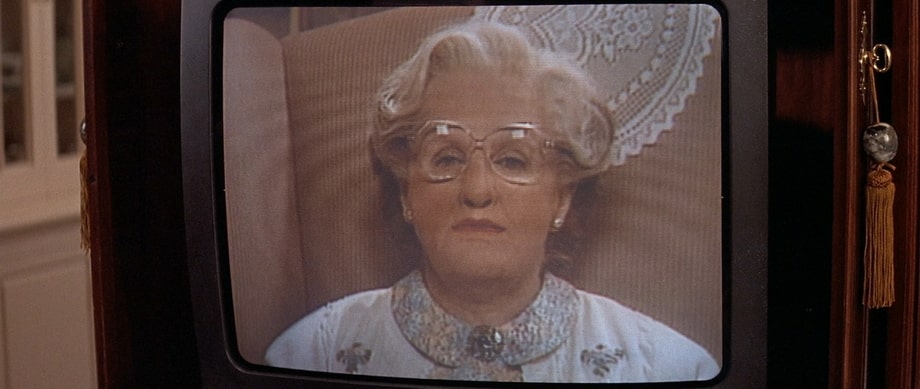
When Daniel comes to the idea of being transformed into an elderly woman, he does not care much about his self-regard when dressed as a woman. The need for self-worth means nothing to him if he can’t see his children daily. The movie even makes a joke about Daniel’s appeal to his brother gay ‘to make him a woman’. While many divorced men are more concerned about their personal lives, Daniel sacrifices such kinds of relations or a macho image to become Mrs. Doubtfire. The story makes a lot of fun of it in such scenes as a robbery attempt on the street and getting acquainted with an old bus driver, who likes natural women from Europe. Being a forty-year-old man, Daniel does not hesitate to ‘come back to school’ to learn new skills to fit the exaggeratedly skilled Mrs. Doubtfire. He can’t say what he thinks to Stuart (Pierce Brosnan) and has to pretend that he is always delighted to see a potential lover of his former wife and a man who may become a stepfather to his children. By making these sacrifices, Daniel Hillard adapts himself to new realities and learns how to be present in the lives of his children under new circumstances.
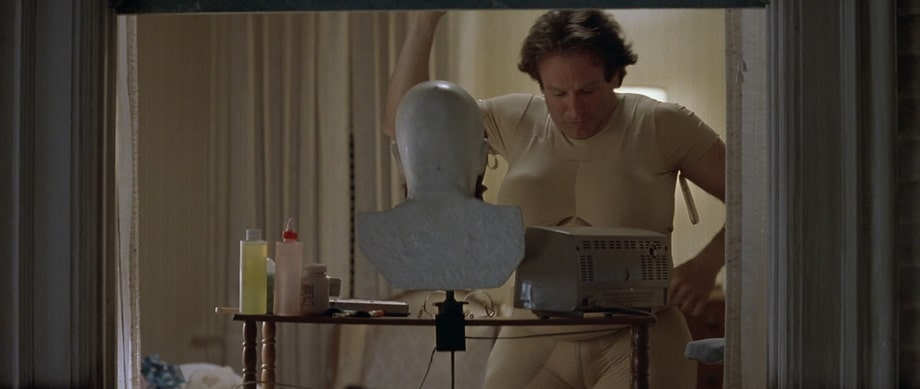
As I have stated above, it was not Daniel’s choice to go through the divorce, though he bears equal guilt, to lose constant access to his three children, and to leave the family home. On the other hand, all his previous doings or negligence finally brought postponed consequences. In a wider sense, years of ignoring Miranda’s feelings and the holes in their marriage resulted in the breaking point, when she became an unconditional believer in the need for divorce, teaching Daniel a lesson and restricting his right to see children not because being a bad father but because being a bad husband to her. For years, Daniel used to change jobs frequently and live at the expense of his wife. The lack of a steady job and savings convinced the judge not to let Daniel spend more time with his kids. The fact that for years Daniel left housework to Miranda after her long working days of ‘career-making’, made him incapable of creating a comfortable environment for children in his new apartment, which looked like a mess even weeks after moving. His lack of talents, except for ‘making voices’, did not give him a chance to get a good job and to impress the social worker, Mrs. Sellner. Having a good sense of humor is a good virtue, except that jokes will not make you a good professional, husband, or at least a mature man.

In the first weeks after the split, we see the same Daniel, who tries to make jokes in appropriate situations, keeps his living space in a mess, and spends so much effort trying to offend Miranda even in the presence of their children. The coming of Mrs. Doubtfire, a new identity, becomes a breaking point, which makes Daniel push harder and invest much more effort in becoming a better version of himself. Working half a day at the studio warehouse is not enough anymore, and taking care of their house has become a second job for him. The lazy Daniel of the past makes space for a person who goes to one job early in the morning and then changes his identity to become Mrs. Doubtfire, who works another four hours until 7 p.m., thus extending his working day from the early hours to late evening. We see a mature man who watches a cooking TV show in the evening and later improves his culinary skills. Daniel now does the things that he had ignored before when Miranda needs a helping hand. It is too late to save their wife-husband relations, but Daniels can now take care of his family in such an unorthodox way.

Becoming Mrs. Doubtfire means not only putting on a believable mask or changing voice. Daniel faced the necessity of creating a whole new personality who was in all ways better than he ever was. Adopting new values turns Daniel into a better version of himself. In the beginning, he just pretends to be a good person and skilled housemaster, but with time, he indeed becomes better, taking the best features from Mrs. Doubtfire, a creation of his. He gives Miranda an ideal housekeeper and thus unloads her stressful environment. Daniel’s transformation works not only under a mask but by doing new things or differently, he steadily becomes a different person. Daniel 2.0. For years, he lacked either patience or subordination to prove his professional worth and put his freedom above all. Now, after the painful experience of divorce and leaving a family, and Miranda’s cold truth about Daniel, a life in a rented apartment, and job assignments at the warehouse, he does not regard himself as the focal point of the universe. Daniel cuts his self-esteem and expectations from life significantly and starts to make tiny improvements and respect other people more.


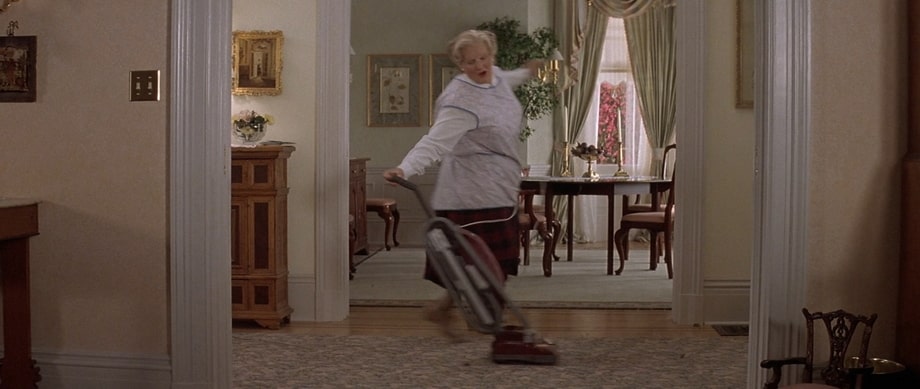
Daniel does his voice with the dinosaur toys and attracts the attention of Mr. Lundy, a man who is not obsessed with power and has backed the most boring show on TV for children. Even though the image of Mr. Lundy is sugary, it is Daniel who finally gets his chance to fulfill the actor’s potential. Toward the end of the story, an accident gives Daniel the idea to use the image of Mrs. Doubtfire in the new educational show for kids in San Francisco. A made-up elderly Englishwoman became a headline for the channel, even though this image was later condemned by the court when a judge recommended Daniel a psychiatric care. Finally, Daniel’s ‘making voices’ gave him a high-paying, steady job and the admiration of many, both kids and adults. Even Miranda, who was shocked by the bare fact of Daniel pretending to be Mrs. Doubtfire, later puts high esteem on his acting skills on TV. In one of the last scenes, she finds her way to the TV studio and congratulates her former husband on his success. After years of failed temporary jobs, Miranda appreciates Daniel’s changes not only because he now earns money to become supportive of children, but also because he has changed his attitude and does a useful job.


It is unclear throughout the movie, but Daniel probably finally finds time to spend with his brother Frank, who is gay and lives with another man, though he ignores his mother. Daniel becomes a more responsible father, whose agenda now goes far beyond amusement and entertainment. He helps Lydia with her homework in linguistics and makes children perform housework and study instead of watching TV, which he probably always did with them before. Instead of playing ‘a good and a bad cop’ in the eyes of children with himself and Miranda taking these roles, Daniel now took the hardest part in the bringing up, leaving Miranda a chance to speak peacefully with Lydia, Chris, and Natalie. Even when the two elder children find out about the true nature of Mrs. Doubtfire, they put even more effort into their education to help their father do his job. In a matter of just a few months, Danien changes his mask of a ‘fun’ parent into a responsible one, who does not need a whole zoo to make his children laugh. After a painful experience of being limited in his time with children, Daniel finally takes parenting very seriously to see them more often. At the beginning of the story, he lacks responsibility and acts like a child, while toward the end, Daniel takes responsibility for his actions when his real identity becomes obvious.


Apart from becoming a better father, Daniel finally finds time and desire to listen to his now-former wife. He can’t turn the situation around and play all events back, but he can understand his faults. Because Miranda believes that she opens her soul not to Daniel but to another person, a woman first of all, she voices her formerly suppressed feelings to Mrs. Doubtfire. These kitchen small talks opened a whole new world to Daniel, who could not imagine how hard it was for Miranda to take care of the four, the house, and her career. He understands that ignoring someone’s feelings or shifting focus on jokes is not a good idea if you care about that person. Indeed, Miranda was not open enough with Daniel about her feelings and the extent of her unhappiness, but it is also true that he never asked her seriously and failed to see her perspective on their marriage. At the end of the story, Miranda understands how much effort Daniel put into the image of Mrs. Doubtfire to be closer to her and their children, his efforts to hear her pain, and to become a better father. She finally concludes that Daniel is a good father, that he deserves a better schedule with his three children, and that they are his children to the same extent as they are hers. Miranda is touched by Daniel’s TV answer to a little girl whose parents went through a divorce.


Let us be aware that Miranda’s attitude at the end of the story is completely different than during the first court. She listens to the judge’s statement and disagrees with his conclusion. The point here is that she can change the situation if she wants to, and Miranda understands what is best for her children,” to spend more time with their father, even though she will never be close to Daniel one more time. In this vein, it is Miranda who went through another transformation as the second protagonist of the story. She leaves her hardships behind and starts a new life with a new man, Stuart, next to her, more free time with her children, and less housework and cooking. She even leaves her disregard for Daniel behind, replacing it with an admiration for his acting talent and his devotion to Lydia, Chris, and Natalie. Divorce does not necessarily mean the end of life for parents and children, but families can still love and spend time together. Time is a great healer, and the Hillard family can change their attitude toward the past to have their future. The husband and wife can leave separately but still be able to raise a happy family.

Read me
Maybe the most prominent post-apocalyptic book and movie—The Road by Cormac McCarthy and its 2009 movie adaptation with a remarkable father and son relationship

Read me
Let’s deepen into the rhetoric of Ex Machina, one of the best SCI-FI movies of the recent years and try to find the answer what it is to be human

Read me
Denis Villeneuve’s Arrival stands out among the notable sci-fi movies of recent years and has pretty much to be discussed in regard of narration, scenery and characters

Read me
The very first Mission Impossible with Tom Cruise spends half of the story in Prague, the Czech Republic, within many remarkable filming locations throughout the city

Read me
While not a movie of primary importance in Marvel Universe, Black Widow Budapest locations take us on an incredible cinematic journey across the streets of Hungarian capital

Read me
An enthusiastic walking tour along the main Indiana Jones and the Last Crusade filming locations in Venice, Italy. Indy and Marcus arrive in Venice, Hotel Danieli, Barnaba Church, the Grand canal and the boat chase scene