


 5,00
5,00
Read me
WALTER MITTY: THE PURPOSE OF LIFE
The driving force of the movie makes an incredible sense in viewer’s own inner world, reflecting the experience of Walter Mitty and adopting to ourselves
MOVIE EXPLAINED

Five years from its release in 1988, the ‘Working Girl’ story is still relevant to people outside New York, in different spheres, men or women, young or experienced. The universality of the story makes Working Girl Tess McGill a reaching character
Except for being a box office success, a nominee for six Oscars, and winning one for the ‘Let the River Run’ song in 1989, Working Girl has gained a kind of cult-favorite status. Over the past thirty-five years, admirers have praised the sympathetic characters, acting, and motivational drive, while critics have seen nothing but another naive story with dubious depictions of gender tension. Just another Cinderella story framed in the decor of New York and the 1980s? A story of a woman and her battle for respect in a man-driven world, written and directed by two men, Kevin Wade and Mike Nichols? While making up my mind to write this article, I was surprised to find so much skepticism and cynicism in the opinions, while lacking a more balanced angle.
Before taking the layers of the story off, the most trivial advice for a more nuanced perception of any movie is to treat it as a movie, an entertaining piece of our culture and society. With all the kindest respect to women, ‘Working Girl’ should not be regarded in absolute terms of ‘either-or’. Either it is a manifestation of feminism or a betrayal of it, a story with intellectual depth or a Cinderella story. Getting so far ahead is something more than any of such cliches, and the power of the Working Girl Tess McGill character lies in its universalism and multipurposeness. While giving voice to women battling their place in the traditionally male world in the late 1980s, it can still motivate people to break barriers, leave their comfort zones, or stigmatize dogmas of what you can do and what you cannot. That’s the whole point with genuinely great stories in literature, theater, or cinema: a story of one character could be upscaled to other professional spheres, social classes, opposite genders, generations, countries, and ages, and serve as such a guiding star for a long period. Thirty-five years is quite enough to praise Working Girl for such an impact.

The story of Tess McGill, Katharine Parker, and Jack Trainer works well because it is not hung up with proclaiming an ‘agenda’ at the expense of the story itself and its characters. It may have some faults in the presentation of social classes and gender, but we live in a non-perfect world, and by requiring Melanie Griffith’s character to serve as an illusory symbol (who supposedly should not have done this or that or did not need a Prince), people get a reverse effect and devalue all the positive that this character has been giving us since 1988. It should sound grotesque to philosophize and speculate on what the movie would have been able to become if… That ‘what if’ and ‘anti-Cinderella’ claims make the positive impact of the story less evident. Getting back to universalism, ‘Working Girl’ can motivate people from different continents, male or female, secretaries or white collars, young or aged, more than three decades after its release. It is not about New York or even the USA, or the late 1980s, or the business sphere, and not even about Tess McGill: this story is about every one of us.
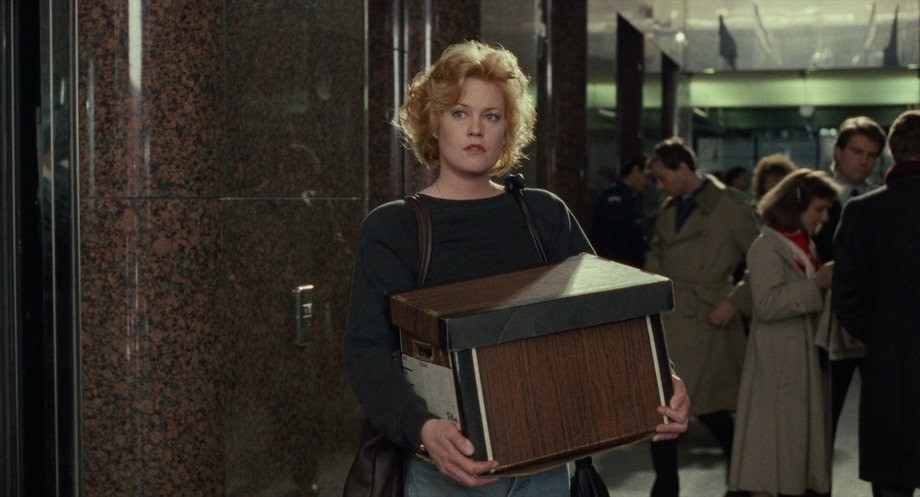
Going into details, the story works well simply because it masterfully combines all important elements, which turns another script into a great experience. We have a sympathetic protagonist played by Melanie Griffith in her best-known role, who has always associated herself with the character. The main character has a clear motivation to move forward and a longing to achieve a personalized vision, shared by the audience. A supportive character played by charismatic Harrison Ford, who impersonates the virtues that Tess had lacked with her ex-boyfriends before. The story has an engaging villain, from whom the protagonist takes inspiration and distances herself at the same time, depicted by Sigourney Weaver. The business rivalry is intensified with a shadow of a love triangle between the three main characters. ‘Working Girl’ takes advantage of several nameable non-trivial secondary characters, such as two-timing boyfriend Mick (Alec Baldwin), supportive friend Cynthia (Joan Cusack), and unconventional billionaire Oren Trusk (Philip Bosco). Tess experiences betrayal and a lack of support, struggles against emotional discomfort, overcomes fears, breaks her comfort zone, acts creatively, preserves her inner modesty, and deserves a happy ending. ‘Working Girl’ is a vivid cinematic example of how a story can stick to the old formula and elements and be entertaining, emotionally engaging, in many ways original, and sometimes outstanding in narration and characters.

Getting back to the conventional references to Cinderella, Tess McGill’s story takes advantage of the conceptual simplicity of the European folk legend but reinvents and improves key elements. Our main female character is not a victim of the circumstances anymore, nor is she sitting and waiting for a prince riding a white horse while being helped by outer magic involvement. Tess spends all her free time on self-development; she is an active participant rather than a recipient of the good she supposedly deserves. She does not wait for a prince to find her and check with a fancy shoe; she buys her shoes, improves her appearance with every scene, and decides whether to trust Jack Trainer or not. Her rival Katharine is a much more complex nemesis than a stepmother, as she pretends to be kind to Tess, and the latter wants to copycat her offender. Jack is loyal to Tess and deserves much more respect than Mick, but he is a mediocre player in the business world of New York (a Kingdom). It is Tess who arranges a meet-up with Mr. Trask. Neither the classical version of Cinderella sought recognition and respect in a man’s world. At the same time, McGill also makes a journey from an ‘ugly duckling’ (metaphorically, of course) in a swamp (forgive me, Staten Island) to a remarkable swan in the heart of a kingdom (Manhattan). A modern princess thus, is not a virgin of kindness in a palace but a full-hearted, self-confident woman who lives in her shoes.

It is unimaginable to speak about ‘Working Girl’ and Cinderella without mentioning another successful (in fact, much more profitable at the box office) movie: ‘Pretty Woman’ (1990). Despite some common elements, the character of Julia Roberts had neither a moral compass like Tess nor her burning desire to learn and change her life, nor was she a self-starter and lived as luck would have it while going with the stream of nightlife in Los Angeles. With all my love for ‘Pretty Woman’, Vivian just hit the jackpot when a wealthy prince stopped his car next to her, and it is depressing to philosophize if he did not. Tess rejects even the possibility of having sex for promotion and dares to break some rules instead. She pretends to be someone else on a social and business ladder, and toward the climax of the story, she faces the consequences of her choices, both positive and negative. Vivian’s story in ‘Pretty Woman’ (leaving the fact that she was a prostitute) is a model for those who sit in a chair waiting for a miracle, while Tess is a guiding star for people who build their own lives with decisive actions. More than that, reaping the fruits of choices made is a more essential experience than waiting for the turns of fortune. Tess McGill covers her journey from a ‘working girl’ to a businesswoman in a way that shows us that ambitions are both our strength and a source of pain.

It turns out to be impossible to voice thoughts about ‘Working Girl’, suggests Tess McGill’s character analysis, without the evident metaphors arrayed by movie creators. The opening scene and the bird’s flight leave us weak at the knees with the Statue of Liberty and a few moments later with the distant panorama of Manhattan, with the ‘Twin Towers’ still standing in 1988. Thirty-five years later, we can’t imagine this movie without the ‘Let the River Run’ song performed by Carly Simons, even though only a few movie nerds like me acknowledge that the song won an Oscar/Golden Globe/Grammy. It pleaded for millions of people to ‘come to New Jerusalem’ without a direct mention of New York; still, the image of the city is very evident. One of the centers of the modern world, which was founded just four centuries ago, was a fixed idea in the 1980s and it is today. Only a few of the hundreds of thousands of people who come to live and work in New York every year are descendants of Lenape Indians who once owned the area before the 16th century. In the XX century, the city became a symbol of new opportunities, the newest frontier for the able-minded, with Manhattan becoming a destination point for the most ambitious: the city inside the city. Story author Kevin Wade openly acknowledged that ‘Working Girl’ tells the story of modern immigrants who come to a new ‘Land of Promise’ in crowds every day.


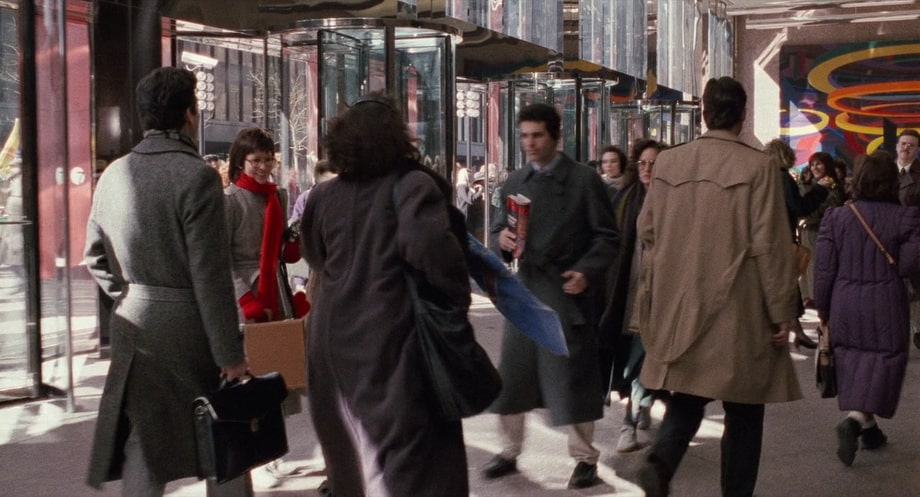
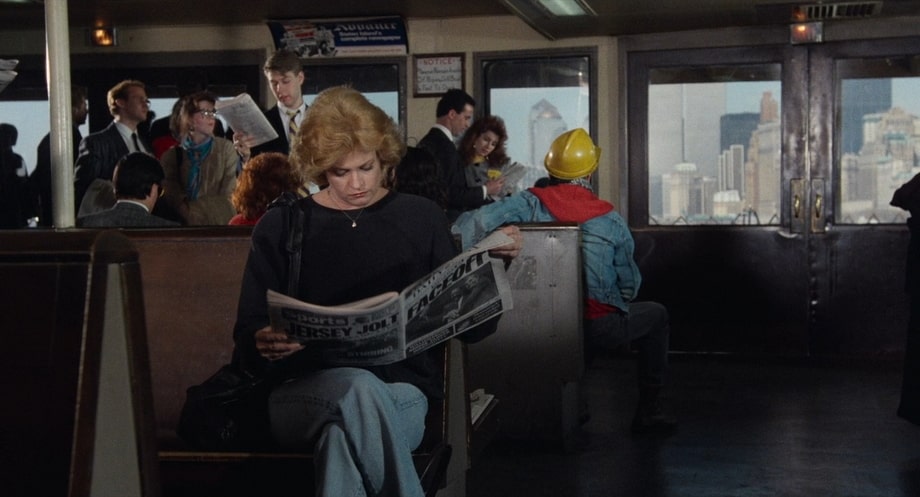
In this opening scene, Tess McGill is no one but a woman in the crowd, one among many, a few thousand people on the board of Staten Island Ferry, which runs every twenty minutes for the Southern part of Manhattan. ‘Let the River Run, let all the dreamers wake the nation’ symbolizes this nameless flow of human beings who ride for work every day, seven days a week. How many interesting stories do they have, how many dreamers finally achieve what they want, and how many Tesses fail? People dream of slipping into a bigger pond with larger opportunities and not being ripped by hungry sharks. The visual representation of Tess throws no doubt about her working-class background on the one hand and still being a stranger in a world of huge skyscrapers and formal attire on the other. A brown leather coat, needless use of makeup, a tousled mop of long hair, suburban clothes, a tight skirt, polka dot tights, and cheap jewelry. Once she finally reaches her workplace amid a noisy open-space office, Tess changes her convenient athletic sneakers for heeled shoes, an everyday part of a routine of modern Cinderella-like switching of identity. Tess, like her best friend Cynthia (Joan Cusack) and other secretary women depicted in this movie, looks like ‘working girls’ rather than ‘business women’.
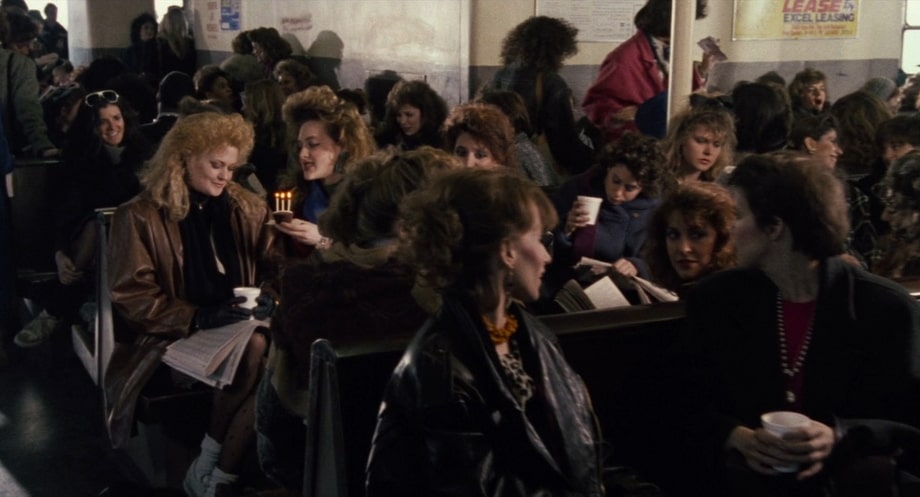

The appearance of all characters in ‘Working Girl’ is a cinematic achievement of Ann Roth (born 1931), an icon-like costume designer also known for ‘Wolf ‘ (1994), ‘The English Patient’ (1996), and ‘Cold Mountain’ (2003). It is important to note that director Michael Nichols and costume designer Ann Roth collaborated on thirteen movies, and The Working Girl is one of their best works on screen. The cinematic experience they gave us could be explained in simple words by a well-known wisdom: First impressions are most lasting, or are half the battle. The story disturbs us with bright, categorical, self-explanatory visual images of people. Unfortunately for Tess, she is judged by her social and working background and appearance rather than her skills and potential, a fervent desire to develop herself, and to see behind the walls. She, like thousands of nameless Staten Island Ferry passengers, is a book judged by its cover. At the beginning of the story, Tess looks and behaves unnaturally for the business pond she aimed for and loses the style battle. Ann Roth made multiple ferry journeys for Manhattan while preparing her costumes for the movie and in-office scenes; even the crowd shots, extras were masterfully assimilated with real NY personnel.

‘Dressing shabbily’, according to the words which Katarine later quotes, diminished Tess’ resourceful working and studying. She has no time for lunch with her best friend because of speech class (later we see the book called ‘Pocket Guide to Good English’ amid Tess’s belongings), and Tess is not ready to miss her emerging market seminar after working hours, even on her birthday. Despite having a degree, her resume is not the one that can impress someone in Manhattan, a world of extreme competitiveness, and Tess is a thirty-year-old, quiet, modest, and ambitious girl from a distant district of New York. Despite her low position, Tess McGill closely follows stock market reports and has a good understanding of the business environment on Wall Street. At the same time, her bosses at the beginning of the story do not put high esteem on McGill and even send her to a dubious encounter with a drunk man played by Kevin Spacey. We find out that Tess has to change her work for the third time in just six months, which of course leaves us a hint that she has rough edges, leaving beyond the assumption that all three bosses had been pimps. Her later leaving the office would lead Tess to work for Katharine Parker.


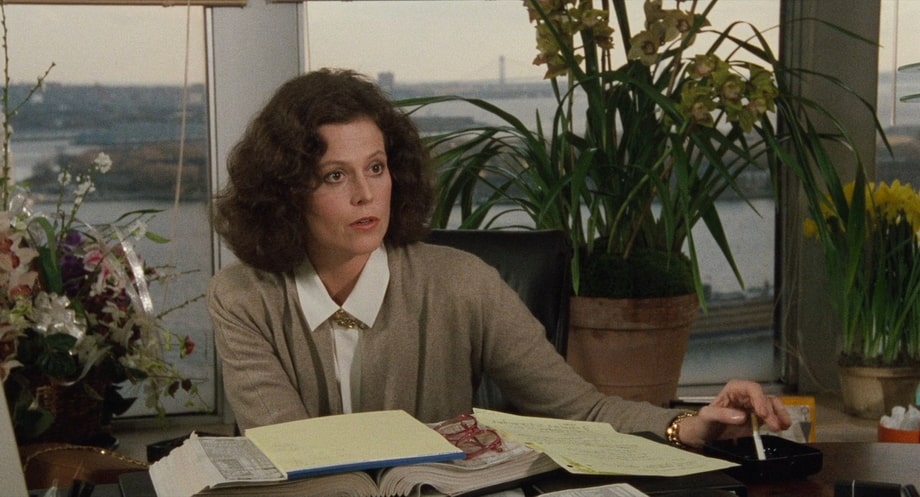
Every cloud has a silver lining, and a humiliating situation with a fake job interview in a limousine-like car, and getting fired from the third company in six months may become a starting point for something new. Tess had no future at the latter workplace, and her winning ticket now was the position of secretary for Katharine Parker. Probably for the first time, at least in the last six months in Manhattan, Tess is going to work for a female boss, an experience she had lacked before. In the previous period, she not only had to experience a negligent attitude from the opposite sex but also lacked a role model to learn from—the fact that makes Katharine Parker by Sigourney Weaver, something more than another cartoon-like villain. A new boss is a woman, and there is no more space for self-justifications based on an alleged misogynistic environment: you either work like hell and adapt, or get the fourth strike in a row and get out with one bag.

From the very beginning, the movie draws a vivid line between Tess and Katharine, intensified by the latter’s quoting of Coco Chanel. The new boss appears to be from another planet when compared to previous painful experiences. Katharine encouragingly says that Tess to look terrific but should reconsider her jewelry approach. One would say she expresses politeness, but on the other hand, Parker underlines her superiority and mentorship, and actually, she has every reason to do things in this way. The movie scratches the differences between the two women not only in dressing but in the manner of speaking and behavior, level of self-confidence, and taking advantage of the background. Feel no doubt that Katharine is from a wealthy family and got the best education and mentorship possible, and as a book, her cover is treated by the world appropriately. While Tess looks feminine, Katharine looks ladylike. In simple words, McGill is a proud, rough-in-edge, dependable button pusher, and Parker is an elegant product of high society, packed in the office environment of New York from the 1980s. Speaking in terms of Jane Austin, Tess is a model of a girl from a poor family who works hard on a farm, and Katharine is an aristocratic girl invited to dance at prestigious balls. The movie even explores this idea when Tess looks terrible among the steam from Asian dishes at a social gathering, while Katharine takes advantage of the people present.
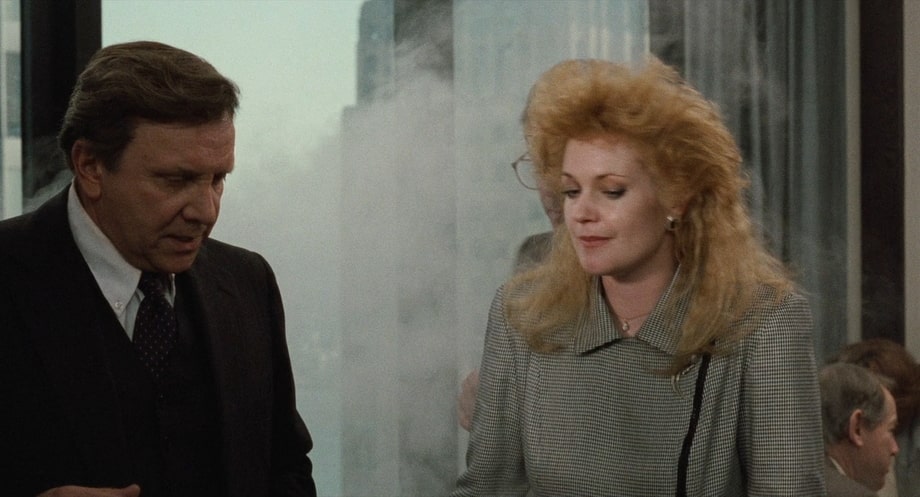
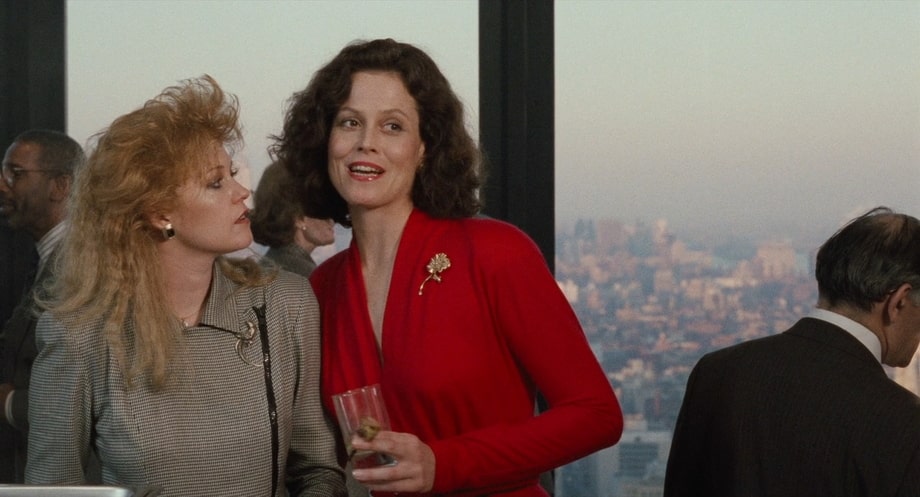
Tess had not a glimpse of the Wall Street experience that Katherine had possessed in the previous years. She tries to improve her English to suit the environment in Manhattan, while Parker parades with her free German and maybe knows several other languages. Of course, as the story goes, the movie simplifies the difference between the two by depicting Katherine as a manipulator rather than an achiever, but in fact, she had skills and experience that Tess could not get in several weeks, and by making one deal for Oren Trask. On the other hand, Parker does not pay much attention to Tess’ education, as the night school college probably means nothing to her. Of course, at the very beginning of their encounter, Tess regards Katherine very highly and sees her as a winning lottery ticket. McGill still does not understand that although they are peers (and Tess even makes an inappropriate joke that she had never worked for someone younger than her) and both women, they are not equal. More than that, Katharine’s encouragement about one team is just the words that should be said. Tess thinks that her mess of ideas could be of great use for the company.
As I have said above, Katharine Parker is not a classical nemesis to a protagonist. She is a product of her environment, a daughter of her parents. In an ever-lasting dispute between form and substance, Katharine chooses form and cares so much about self-representation to the world and the finished bright of her image, either to top executives or to her personal assistant. One of the lessons the ‘Working Girl’ teaches us is that we can still learn from people who may mislead us in some ways. At the very first meeting in the office, Katharine gives Tess a clue, a destination to move forward, and even more practical advice regarding jewelry. As time will show, Tess would not be above Parker’s role model even after finding out the truth about ‘playing in a team’. Similar to a film costume designer who used to ride from Staten Island to Manhattan for an influx of ideas, both Sigourney Weaver and Melanie Griffith derived inspiration from female executives in New York.

Leaving aside social and educational background and appearance (Tess would soon fit the model), the vivid difference between the two women lies in their attitude toward other people, even when Tess says she has accepted the rules of a game. McGill does not want to turn her ambitions into reality at the expense of the others (except Katharine in some way), and she believes in teamwork and treating people as equals. In a wider sense, she tries to treat people in the way she wants to be regarded. For many years, she lacked appearance and status, and now Tess tries to combine them with her intelligence, diligence, and integrity for people who deserve it. Needless to say, such a role model is more attractive and, back in the 1980s, correlated with the convictions of many women, even though the image of Tess McGill is idealistic and cinematic in many ways.
Katharine Parker exists on the other spectrum of women’s endeavors and appears to be more stereotypical. Her way up the corporate ladder is not so attractive to many viewers, not only because of her background but also simply based on Parker’s way of treating other people. The cliche lies in the fact that Katharine does not shy away from using other people for her purposes, whether they are men or women. She openly uses her femininity with Jack Trainer or a man in the scene with ‘Dim Sum’ catering to get what she wants while pretending to be one of them, an equal. When dealing with women, as the story shows, Katharine easily explores their loyalty, integrity, and ideas if she needs and sees potential for herself. It is safe to assume that stealing Tess’ idea was not the first and only case of such kind for Parker. In a wider sense, Katharine respects neither women nor men and uses both categories for her ends. She betrays Tess similarly to the latter’s ex-boss, but does it with charm and a smile, politely pretending to be a friend and a teammate. We often see Katharine wearing red clothes, which signals her dominant position, even though her words are sweet like honey.

It is understandable why an image of Katharine Parker may be so prohibitive for a women’s audience since she betrayed her female peer in a traditionally male world and in other circumstances (for example, in reality, not in a movie) could have stolen Tess’ chance to succeed. The ever-lasting problem with the character lies in the fact that by presenting herself in a particular way, Katharine taught men around her to respect her and crave her attention while giving less respect to women who are inferior in status, like personal assistants. So, instead of improving the position of women in the corporate environment in the 1980s, Parker only drew a thicker line between working classes: gender is not as important as social background, appearance, power of persuasion, self-presentation, and alleged status. When it comes to secretaries, Parker does not consider that Tess might not have just enough money to dress herself as elegantly as an executive, and Tess would have to ‘borrow’ things to meet the standards. People who have a restricted budget have a hard time looking well, and to earn more money, you have to look well. In this vein, stealing an idea from someone who is not equal to you looks even more chilling, even though Katharine admits Tess’ intelligence and ideas and intentionally leaves her in a submissive position of a subordinate rather than equal, a few steps behind polished Katharine Parker with a remote possibility to become a real team. Such an attitude and a feeling of self-power appear to be Parker’s beginning of the end, as Tess has even more virtues to finally put the idea into reality.
Before getting to Tess’ transformation, it is reasonable to speak of the ultimate challenges she faced in the prologue, the severities that actually made changes possible. The movie leaves us with no details about the previous two failed experiences of work experiences in the last six months, but the last one was a kind of betrayal. David Lutz, played by Oliver Platt, regarded Tess as legs in a skirt and was ignorant about her education or business ideas. It looked twice as hilarious because he appeared like a man among dozens of others in a crowded office space, even without a cabinet. By himself lacking a status, Lutz tried to feel a little more important at the expense of his few subordinates. His decision to send Tess to an inappropriate sex-like meeting signaled not only a lack of respect for her as an equal but of dealing with women with no respect. With such an open disregard for other people, such a character will never make a few steps up the corporate ladder. One would say that Tess had sent some signals with her clothes and cosmetics, but that is not a reason to treat her like a prostitute. How Tess confronted such a situation: she responded in kind and humiliated her boss in front of all present in the office and, of course, was fired from the job. As the story shows, leaving toxic relations is a way out, even if, in the beginning, losing position or relations looks too challenging.


When it comes to Katharine Parker and her betrayal of Tess’s trust, the latter regards the situation as more painful than any previous negligence. She probably never expected David Lutz to be an honorable man and a fair-minded boss, and after all, he was a man in a man’s world. His conduct was brought about by his attitude toward women and his nothingness. The career gap between Tess McGill and Katharine Parker was much greater, and the fact that the latter stole the assistant’s idea signals disregard toward her peer. More than that, the new boss is a woman, and in some feminist way of thinking, Katharine betrays Tess’ craving for self-actualization in society in a business environment led by men. There’s more; she did this for her deceptive purposes to boost her career at the expense of another woman. On top of it, Katharine’s betrayal is even more painful because of her artificial smile, kindness, and false hopes for making a team. Tess wanted to look, sound, and act like Katherine, and such conduct ruined McGill’s picture of the newly created world. If we take a look at the letter on Katharine’s computer, she undoubtedly claimed that it was her idea, a ‘lightbulb in her head’.


Every good story of a character has to have a section and circumstances to make the protagonist go through hard times, challenging reinterpreting of one’s life to make changes. ‘Working Girl’ gives no quarter to Tess and directs two betrayals against her in one day. It is safe to assume that she may not take revenge on Parker without Mick’s foul play a few hours later. This fact makes the character face a situation when Tess has nowhere to go back: neither to get her fourth strike in New York nor to go back home and live with an unfaithful man on Staten Island. Her only way out of the humiliation is to go forward and turn her ideas into reality. While the movie focuses primarily on Mick taking pleasure with another girl and his pathetic comments that it was not what it looked like, most people miss the fact that it was Mick’s unsupportiveness for Tess that caused the break, and the ‘bed pleasure’ with Doreen was the climax of the problem but not the starting point.


At 21:34, we see Tess and Mick walking home after her first day at work with Katharine. Tess is full of enthusiasm and speaks wholeheartedly about her endeavor and a sense of self-respect, but Mick listens to her words with empty eyes and all he has to say is: ‘Tess, that’s great, but let’s step on it… or the pizza’s going to freeze.’ She had never cared much about Tess’ ambitions and dreams. All he needed was a simple-minded girl to take time with who would never surpass him with his mediocre middle-class work. Mick needed a female, but not a woman, and not a businesswoman chasing Manhattan. He leaves Tess’ suggestion to go out in the city, of course meaning outside Staten Island, with no reply. Going even earlier at 8:08, Mick gives Tess a birthday gift, lace lingerie, which, of course, is a gift more for him than for Tess. She comments that she might want something she could wear outside of the apartment, and it was not on Mick’s mind to help Tess do something in the outer world. We later find out that Mick had a small boat business, and he needed a girl to work with him with no ‘crazy’ Manhattan-like aspirations. After Tess’ transformation, Mick admitted that she ‘looked different’ but diminished her appearance by saying: ‘What, did you have to go to traffic court or something?’ We understand that they have always lived in different worlds, and now Mick is more than ever ready to assume that Tess might be better than him and their social surroundings.


Tess gets her first important lessons from Katharine during their very first encounter, and although she makes some improvements just a mile up the road, her impactful transformation begins after a double betrayal. She once came to Manhattan, got an education, opted for extra classes to find out secrets of this complex business world, and hints at a game she never was meant (by the others) to take part in. Leaving Mick and finding out Katharine’s dirty work, Tess decides to leave her background behind, or at least hide it carefully. ‘Fake it until you make it’: this is her new motto. To succeed in this game of business and success, ideas and respect, Tess would have to change herself to fit the environment, to leave her long hair, tight skirt, and polka dot tights in the past, and create a new version of herself: Tess McGill 2.0 or at least 1.1. at the beginning. She spent years playing a fair game, learning and being a faithful friend and girlfriend, making ferry journeys five days a week.

The most curious idea of the movie is that while being crushed by Katharine’s ill act, she chooses Parker as her role model for simulation. She needs to imitate the confidence of a businesswoman in a man’s world to show expected qualities, and Tess opted for Parker to follow. Of course, not her attitude toward the faith and hopes of other people, but Katharine’s style, clothes, behavior, and confidence. At 27:58, Tess tried to imitate Parker’s way of saying it by replaying voice recorder notes. Even before a decision to take off her clothes, Tess tries to fit her new boss. Getting back to Cinderella references, throughout the story of ‘Working Girl’, Katharine Parker plays two roles at a time: a fairy godmother and an evil stepmother. She takes pride, freedom, and the potential to give a new image and opportunities. A Godmother/Stepmother from Wall Street in the 1980s. Once she finds out about the dirty playing, Tess stays in Katharine’s apartment, wearing her boss’ elegant clothes. Before going to a business dinner party (an allegory to a ball), Tess asks her best friend Cynthia to cut her hair: ‘You want to be taken seriously; you need serious hair’. Her Staten Island hair does not belong to a 6,000$ dress.


Tess understands that the book is judged by its cover, at least in the beginning, and no one, Jack Trainer in particular, would have listened to the secretary’s ideas on the multi-millionaire deals. She hides her intelligence and creative thinking for some time under an expensive dress and jewelry, or better to as she adds a necessary framing to herself: creating a brand value around her true identity. It doesn’t take to be a fashion expert to understand that Tess’s choice of dress was not the best one for a formal business gathering. On the other hand, it was this dress that caught the eye of Jack Trainer, a person Tess wanted to meet here. He says that she is the first woman at such events who dresses like a woman. If we take a look at the female part of the evening, indeed, most women do not have their own style but just try to simulate the appearance of the other sex. Later on, Jack will present Tess with a briefcase concerning both her talents and her ladylike appearance. On the next day, she chooses a gray Calvin Klein costume, a square coat, a cream-colored lady’s blouse, and a Chanel purse from Katherine Parker’s outfit, thus copying the image of her boss. She looks natural in Parker’s clothes, and our perception of the character shifts as well, as other characters regard her in a new way.


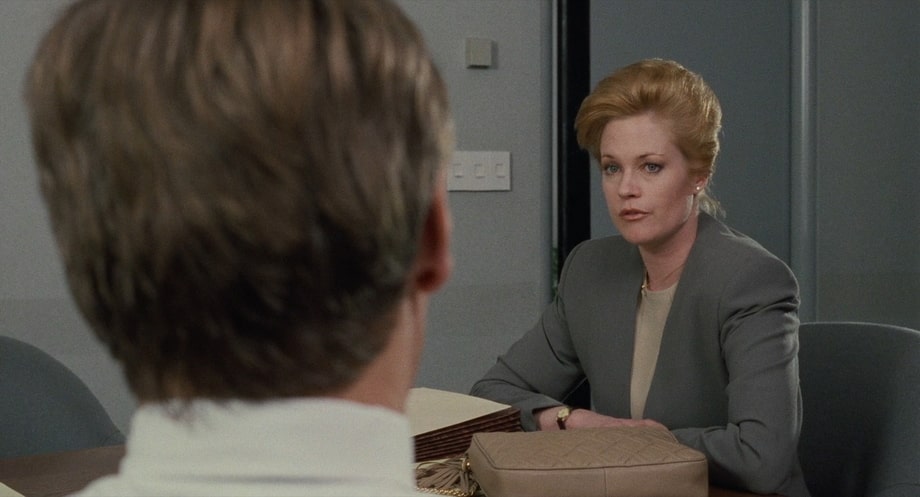
It is important to note that Parker’s stock of elegant clothes was the starting point for Tess to feel different and involved, but later she reconsiders her own choices at her own expense. When Katharine landed on the roof in New York, she looked in the wrong direction and missed the crucial changes in her personal assistant. For Parker, Tess was only a secretary who might take a giant stuffed toy, sacrifice an important meeting to buy some stuff for Katharine, and find wine glasses in the kitchen. In simple words, they are both businesswomen now, and it is hard to guess who is the boss and who is the secretary. A few weeks before, Tess told her best friend Cynthia that her unfair play aimed to make her life better instead of working like a horse and going nowhere. Yes, she has to hide her briefcase beneath the bar counter once she gets back to Staten Island, but Tess’ transformation goes on. At the very end of the story, we see her new look still ladylike and very conservative: a raincoat with shoulders, a blazer, and a blouse with a bow, all in different shades of gray, business style as it is. Her appearance now fully complements her transformation as a person and a professional with inferior experience, but with a fire in her eyes. Maybe she still does not look like Katharine Parker with all her social and Wall Street background, but now Tess should not be confronted with a secretary. Whatever challenges she would face in the future, she would not get back to her early roots and social environment, in some way, a piece of sad news for Cynthia.

1. Cinderella never degraded herself to stealing the clothes of her stepmother and lying to other people.
REALITY. As I have already said above, Tess McGill is a more progressive woman, and a mature reinterpretation of the old story, and there is a difference between a fairy tale and at least a possible story in the 1980s. It is true that Tess used at least some methods of the game and took advantage of the apartment, clothes, and office of Katharine Parker, while the latter was stuck in a hospital bed. On the other hand, she never tried to directly harm her boss or even to voice the truth about Katharine’s conduct; she did not pretend to be another person. Tess only admitted that they both worked in the same company and she never used badmouth or gossip. She wears several dresses and a fur coat, but at the end of the story, she begins to dress her way. Tess’s agenda was only to fulfill her business idea while she still had time until she was fired. The claim that Tess stole everything from poor Katharine is a misreading of the story. It is Parker’s lie and disregard for other people that would harm her in the end.


2. Tess stole Jack from Katharine.
REALITY. Getting back to Parker’s own words before her leaving New York, she talked big and tried to boast of their relations with Trainer to look better in front of her secretary, just to show that it is her choice to marry a man or deny him, despite his alleged proposal, which was only in her head. As the story goes, Jack sincerely admits that he had relations with a woman, Katharine Parker, and he just did not have enough time to completely halt them. Jack was supposed to join Katharine on her journey to Europe, but he refused, and he still had to face an unpleasant conversation with Parker. Regardless of the encounter with Tess McGill, Trainer had made up his mind to break off relations with Katharine. In this scene, we also find out that Tess had never known that she was becoming intimate with Parker’s boyfriend. Tess felt sincere affection for Jack, and there was no cruel plan to take a man from her boss. More than that, Jack was a driving force behind their moving closer to each other, while Tess, for a time, distanced herself from any intimate relations except for hard work.
It is a time and place to say that Jack’s behavior at the party was not a crushing of the image of ‘prince’. He did not make her drunk, as it was Tess’ pills that made her dark. He tried to deliver her to her home (in fact, he would have been surprised to come to Katharine’s place), but Tess was unable to say the address. Yes, he took off her dress, but there was nothing to confront his moral honesty. More than that, Jack expressed respect for Tess as both a woman and a businesswoman with ideas from the very beginning. After all, we are all big girls and boys, and there are neither princesses nor princes in the real world. ‘Working Girl’ shows us people and a story that could have happened in New York in the late 1980s.
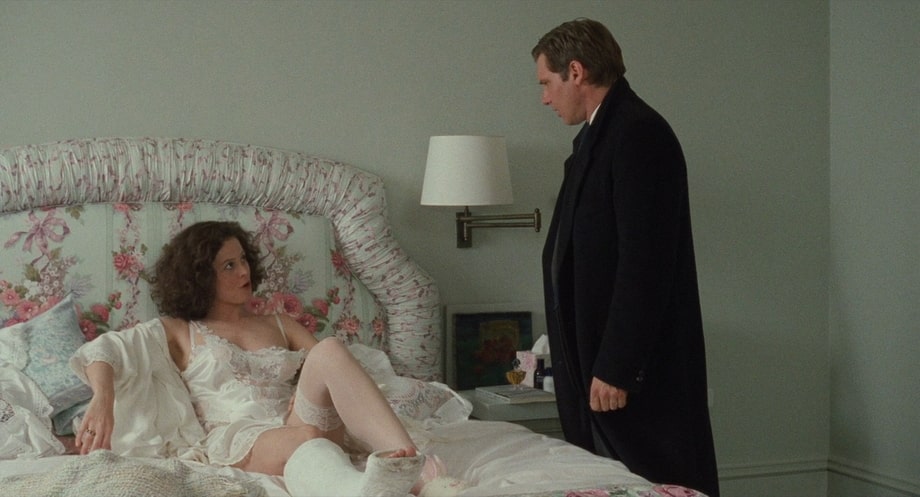

3. The love story between Tess and Jack was unnecessary.
REALITY. The problem with all unreasonable critics of modern cinema lies in the fact that some people want to find flaws, and they do. It sounds ridiculous to criticize ‘Working woman’ for being ‘not enough something’ as we deal with an entertaining story about a woman who not only wanted to have an office and wear a suit but also sought intimate, supportive relations. When someone becomes a businesswoman, she does not stop being a woman or a living human being, whose aspirations are not limited to work, self-realization, and competition with the opposite sex. I would not repeat myself about just why the story works so well, but relations with Jack Trainer do not devalue Tess’ achievements and transformation. The truth is the opposite: she finally becomes Tess McGill 2.0, as unsupportive relations with Mick had been her source of frustration just as much as working hard without recognition. A good partner is something more than someone who sees you only as a bed item; he or she is a friend and even maybe a business partner, like Tess and Jack. No aspect makes people’s relations more tired than some common undertaking, and the story works fine with it. A life plot with Jack, in fact, still motivates women to break the barriers, to stop toxic or unfaithful relations, to seek what they want, and not what critics on the internet claim. She works not out of fear but with conscience, and at a certain moment—who dares to go for broke—the heart of the ‘prince’ becomes an additional ‘bonus’.Would Tess succeed in making a deal for Oren Trask without Jack Trainer? No. Does it make her talents and story less impactful? No. In the words of Forrest Gump: they were like peas and carrots.
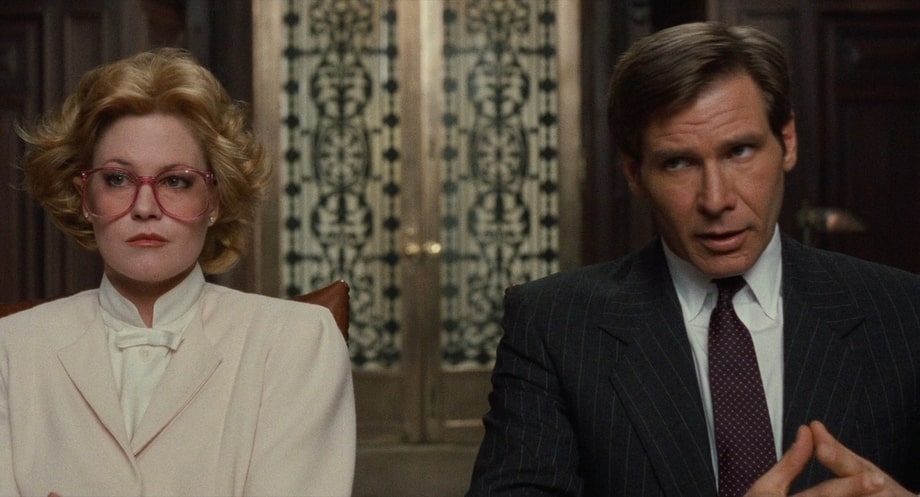
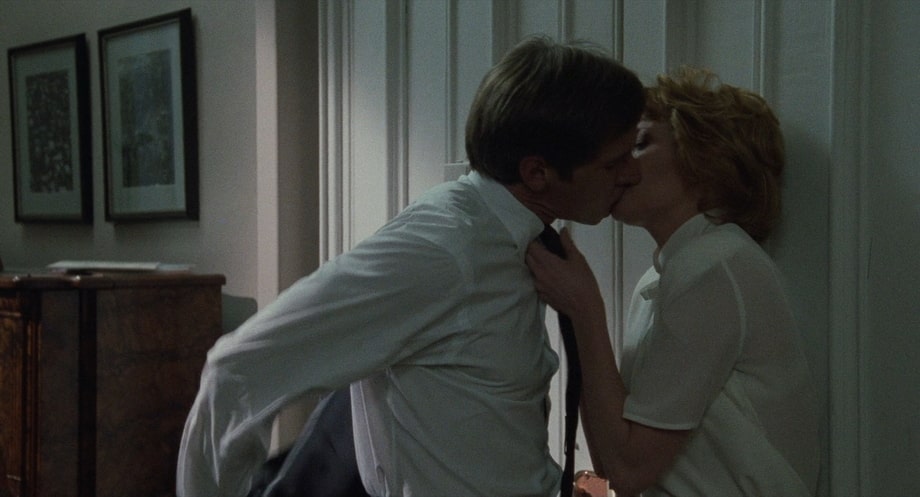

4. Tess’s idea appeared in a newspaper, and her success was no more than a confluence of circumstances.
REALITY. It is reasonable to say that if you have such regard toward ‘Working Girl’, this movie is just not for your skeptical mind. Even the Cinderella story is itself an interpretation of the old ‘from zero to hero’ pattern. People love stories about sudden success, but even more, they get crazy about the characters they can associate themselves with, who can think the other way and outside the box, and this personal, unconventional approach works. Tess could see an idea for Trask just because she was hungry for learning and doing; the New York newspapers were her source of inspiration and information. We can hardly imagine Katharine Parker doing some creative thinking. More than that, Tess was not limited by all the rules of the game, and she regarded things as simpler.


5. The movie ending is dubious
REALITY. Some ill-pleased viewers voice the thought that by having a female secretary at the end of the story, Tess supported the same system. The story gives us evident clues to the change of paradigm. She does not try to criticize the assistant’s appearance, does not come out with her significance, and asks a woman to make coffee only if she wants to. Allowing to call the boss by name should not provoke bad references to Katharine and Tess has made it this way from the secretary’s chair and does not treat people as inferiors based on their social or professional background. It is reasonable to assume that her assistant would experience good times with Tess McGill.


Summing up Tess’ transformation through the story, the revealing of her true identity to Jack and Trask did not break her. Theoretically, she could have gone back to Staten Island and even to Mick, but her idea was to find an apartment, a new job, and if needed, to start all from scratch. The critics of the love line between Tess and Jack miss the point that at the climax of the story, it was Jack who refused to continue making a business deal without Tess. He gave his heart and trust to her now, without a ladylike appearance, status, a Chanel purse, and a personal office, and Oren Trask put his faith in Tess as well regarding her business framing. Just another chance and a few minutes in an elevator sort things out, and both Trask and Trainer understand that it was Tess who could be the only source of the idea. She took advantage of her secretarial background, a craving for learning, and a working experience on Wall Street, thus integrating her Staten Island identity into the world they understand. In this scene of greatest importance, Tess does not have to pretend to be someone else; she has finally made it and does not need to fake it.

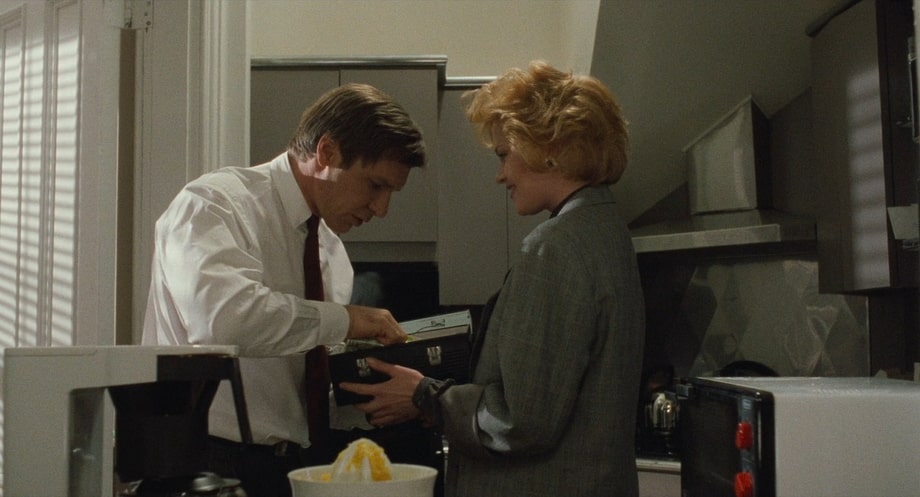
‘You’ve got a power in your belly’: Oren Trask says to Tess. In contrast to Cinderella, who was just a kind virgin girl waiting for a miracle, Tess went through years of painful experience, through sweat and blood in the last several weeks, and like Andy Dufresne in ‘The Shawshank Redemption’, came to be another person at the end. The image of Mr. Trask is, of course, idealized and looks more like a wholehearted magician than a business shark from Manhattan, but it still works out. The benevolent, wisest, silver-haired boss who sees purpose in Griffith’s character. She went through purgatory, proved her right to a new life, and threw off the shell of a secretary. At the same time, Tess McGill preserved her heart and attitude toward other people, modesty, and princess charm. She agreed to start from scratch, and in the final scene, she even considered herself to work as a personal assistant once again. Trask’s words and proposal give us a powerful takeaway after watching ‘Working Girl’, that your background and the way you talk do not define your whole life, and it is hard work, drive, and creativity that may help you gain success.


The ending of the story is vividly symbolic. Tess finally gets her little dream: not a personal office as we see thousands of them as the camera pulls back, but a feeling that someone else respects you and puts a high esteem on you. Tess makes a call to Cynthia, and her former colleague among secretaries jumps up from her office chair to cry out at Tess’s success. If one can do it, another can succeed as well. Now Tess herself becomes a role model not only for a dozen personal secretaries she had worked with through the years but to millions of women and men, who have enjoyed the ‘Working Girl’ since 1989. They are just small fragments of a giant machine called New York, in a way that we are all pieces of this magnificent world with possibilities. Happiness lies not in a financial business only; it is not stuck in Manhattan; we are all makers of our lives and can shape our future. Any of us can act and live as Tess McGill, Jack Trainer, Katharine Parker, Cynthia, or Mick.



Read me
The driving force of the movie makes an incredible sense in viewer’s own inner world, reflecting the experience of Walter Mitty and adopting to ourselves

Read me
Looking back into movie history, Phil Connors from Groundhog Day has blazed a trail among the most debated cinematic characters of all times

Read me
The unexpectedly brief yet emotional epilogue of ‘Me before you’ movie brings us to Paris, France, with all its romantic aura of the French capital

Read me
All 20 Before Sunrise filming locations, a famous romance movie by Richard Linklater, with Jesse (Ethan Hawke) and Celine (Julia Delpy) walking across Vienna

Read me
Significant romantic book “The Light Between Oceans” by M.L. Stedman describes love and betrail on solitude Janus Rock island near Western Australia

Read me
While mainly set and filmed in Florence, Venice, and Istanbul, the third adventure of Professor Robert Langdon, Inferno, was mostly filmed in Budapest, Hungary