Jerry Maguire has much more than just ‘leadership lessons’, and ‘Show me the money’ philisophy. It is a story about friendship and personal relationship
A search for integrity and sincerity for Jerry Maguire – his frustration and mission statement
Jerry Maguire, a classic from the 1990s by director Cameron Crowe, is often cited in the context of ‘leadership lessons’, the famous ‘Show me the money’ quote, as a motivational guiding star for sales managers and financial brokers. The story and its characters can indeed warm up the blood of those who seek motivation in work or sports, who read books about ‘successful success’, and spend money on gurus. For me, Jerry Maguire is a cinematic journey devoted to love and friendship and personal relationships between people. It is a story about a broken person who lived until he was thirty-five years old and had no real friends or a loving spouse – only a recollection of his deceased mentor. Jerry used to wake up in the morning with a feeling of hate for himself, an aching frustration, while being surrounded by rich people, first-class flying seats, and luxury hotel suites. Such a kind of inner emotional bleeding could not be coped with by either a motivational quote, money, or a slap on the shoulder.
Dicky Fox: I love the mornings! I clap my hands every morning and say, ‘This is gonna be a great day!’
It may seem that at the beginning of the movie, Jerry introduces himself as a man of achievements, with pride and arrogance. Seventy-two clients are dependent on him, and his efficiency as a sports agent is so impressive that he usually makes two hundred and sixty-four calls each day, and he generates millions of dollars for his company and sports stars. Way for just a few seconds, when Jerry admits to himself that he has become another shark in the suit. It is obvious that it is not a spontaneous observation, and his transformation from a devoted young professional to a result-obsessed seller took him years, probably a decade or so. Another interesting detail, which Jerry admits from the start, is that he has said nothing about his rising concern and frustration for a few years, thus suppressing his true self out of fear of making a stop. Even slowing down the pace of achievements has become Jerry’s self-imposed jail. While he kept silent, the things and a quest for dollars actually went wrong.
Jerry Maguire: I hated myself… no, I hated my place in the world.
Despite high-sounding words about mission in a sport, a passion, and a quest into the future for new generations, sport has become obsessed with money, commercial contracts, brand positioning, and successful drafting. Director Cameron Crowe saturated the story with indications of such degradation, but the two scenes stand out from the rest. The first one, a seemingly harmful one, shows a sports star who refuses to give an autograph to a kid because he should use only products of a particular brand. It reminds the scene from Forrest Gump, when the tennis racket manufacturer wanted Forrest to say that he had always played with his product in hand. The second scene actually becomes a breaking point, after which Jerry Maguire wrote his mission statement. Jerry does not actually care about the health and future of one of his clients, and he just wants the latter to proceed with his career, despite the son’s concern that the father could die if he continues. Here we can recall references to another iconic sports movie from the 1990s, Any Given Sunday.
Dicky Fox: The key to this business is personal relationships.
In a narrow sense, Jerry Maguire, who once loved sports and assisted in creating one of the most influential agent-service companies in the United States, has become the architect of cutthroat management. It was his example of taking as many clients as he could, making hundreds of calls and meetings, that created people like Bob Sugar. The latter was Jerry’s apprenticeship, but colder and without principles from the start. Sugar has not slowly boiled in transforming into a business shark like Maguire. He was raised in a toxic culture from the start, and it is very symbolic that it was Bob Sugar who finally fired Jerry from the company he had helped to create. But at the time of his revelation and the creation of a mission statement during a sleepless night in Miami, Jerry was not aware of the upcoming events and the consequences of his waking up as a sports agent. He was afraid, yes, but also probably sure that he was doing right and better for the business as a whole.
Bob Sugar: It’s not “show friends.” It’s show *business*.
When Jerry started writing, he aimed to pitch just one page of thoughts to close colleagues and ended with a 25-page document about systematic and conscious sidelining and ignoring the real client’s needs. It is reasonable to say that Jerry Maguire wrote this mission statement from the point of view of a young law graduate, who once loved sports passionately and was eager to take care of his few clients, until it all became a never-ending race for money and drafts. For years, he was telling people what they wanted to hear from him about care, success, and money, and now he finally admitted that he often lied and pretended, like all the other sports agents around him. Jerry has become one of the finest in the business, and he feels his responsibility for forging and cultivating this shark-agent culture.
Jerry Maguire: I am out here for you. You don’t know what it’s like to be ME out here for YOU. It is an up-at-dawn, pride-swallowing siege that I will never fully tell you about, ok?
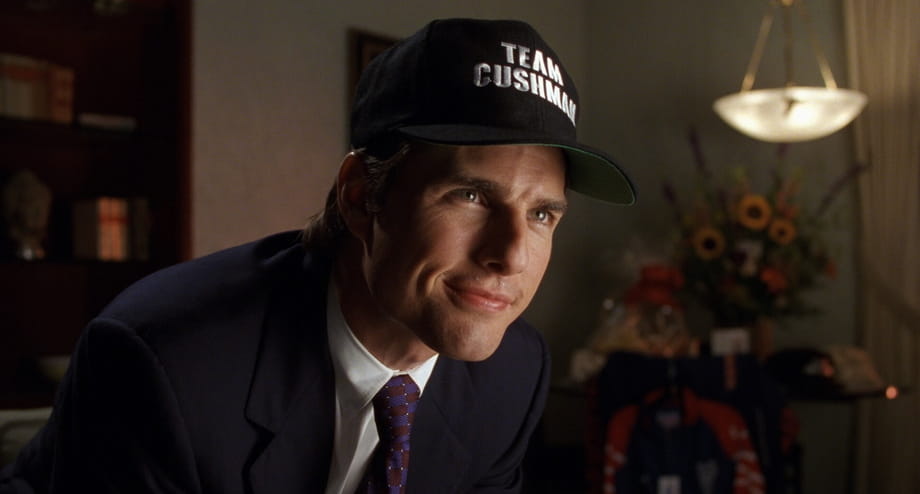
Jerry used to tell each client or a potential candidate that he loved them and his family and that he loved White, Hispanic, or Black more than others, depending on his current agenda. He wore a flat cap with Cushman to get a contract signed with the family, and he was kind and polite with Rod Tidwell’s wife, Marcee. It may seem that Jerry knows all his clients and their relatives, which is a sign of care, but in reality, it was just an obligatory instrument to make them believe in his devotion to them. This was needed for an outcome. For years, Jerry Maguire pretended to be a sports representative rather than actually being such an ambassador for his clients. He measured success not by the well-being of his chief consumers but by their number, successful drafts, undercover deals, as well as business class flights, expensive hotel rooms, and suits for himself. Like the protagonist of ‘Fight Club,’ Jerry twisted this spiral of consumption further and further.
Jerry Maguire: I don’t like black people? I am Mister black people.
Writing this statement was not a revolution, but sharing it even inside his company was a huge risk for Jerry, and he probably underestimated people like Bob Sugar and other sharks, who wanted his place and clients. Sharing this document led to the protagonist’s downfall in the company, but gave a start to a transformation in his life. In a wider sense, Jerry’s mission statement led him to the exact picture he suggested – he lost all his clients except one and could now target all his efforts at Rod Tidwell. When Jerry later asked Rod not to be stuck with the money issue only and to remember the pleasure of playing football and hearing the stadium, Maguaire had just come through such kind of a path himself. Jerry felt no pleasure when he lost his job and prestige, but at least he was now true to himself. Speaking in the words of his statement, at the end of the story, after Rod’s success, Jerry could feel satisfaction and pride. His reputation also gained a new impulse, and other sportsmen now want such a people-first attitude for themselves. Such an approach now distinguishes Jerry Maguire among other sharks in the pool.
Dorothy: How about a little piece of integrity in this world that is so full of greed and a lack of honorability that I don’t know what to tell my son! Except, “Here. Have a look at a guy who isn’t yelling ‘Show me the money.” Did you know he’s broke? He is broke and working for you… for free! Broke. Broke, broke, broke.
The bubble of ‘successful success’ and losing the pretended friends and admirers
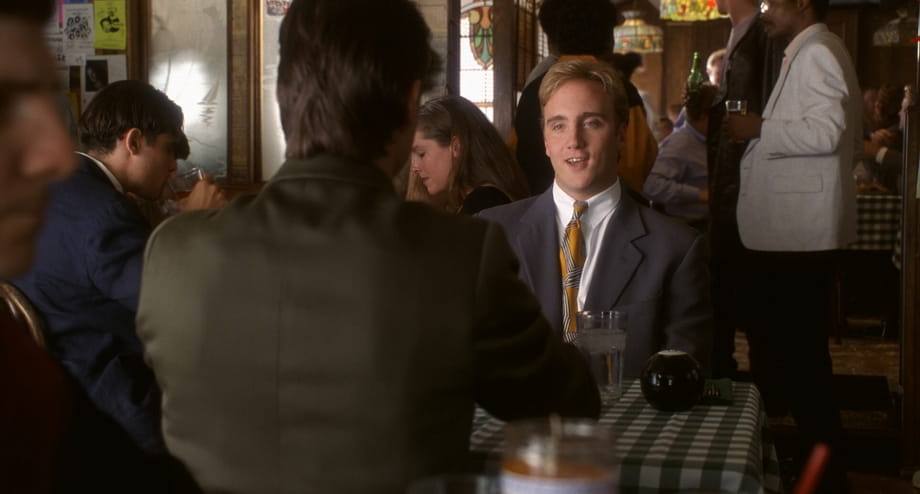
Jerry Maguire was charged with enthusiasm and anticipation when he shared more than one hundred copies of his mission statement. The upcoming day seemed to become a triumph of his worldview when dozens of his colleagues applauded the text and Jerry’s courage. A new vision of treating clients and making money has been accepted and embraced. As we find out just a few moments later from the comments of the two smiling men, these bursts of applause and adoration were pretended and double-hearted. From this moment, Jerry Maguire, despite all his previous achievements, was perceived as a dead man walking. Less than a week after this moment of triumph, Jerry was fired by Bob Sugar, a man he himself had mentored. For years, Tom Cruise’s character has been a seamless part of this rotten system, and until he played according to the rules, he was treated as successful and even more than an equal.
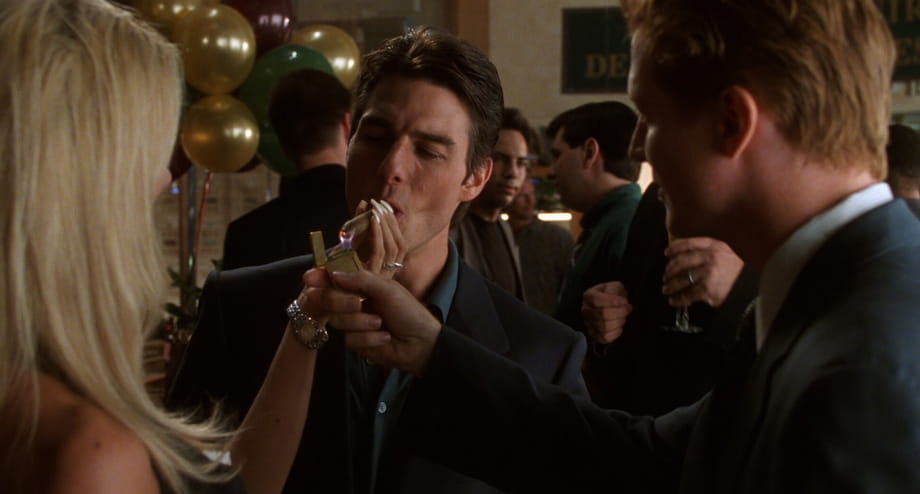
Another example of double-faced treatment is Jerry’s birthday party, and not because of the video with ex-girlfriends, but just look at how many people pretended to be Jerry’s friends. They came to his party, they smiled, told pleasing praises, but as the story shows us later, many of them hated Jerry’s achievements; they had a grudge against him and wanted to take his place, though the system will later chew them as well. Jerry Maguire (Tom Cruise) was a kind of alpha hunter in his shiver of business sharks, and when he announced that they all should eat less meat than they can handle, the band expelled Jerry from their red ocean. Taking this Blue Ocean Strategy further, being expelled from the school of sharks opened new possibilities for Jerry to find his blue ocean, where his client-first approach will be appreciated.
Speaking about Avery (Kelly Preston), Jerry’s girlfriend and a potential fiancée. There is an illustrative moment when his ex-girlfriend and people whom he considered friends say that Jerry hates being alone; that’s why he needed a relationship. I would not argue with this statement, since every normal person does not like to be alone; we want to be accepted and accept others into our lives. A peculiar detail with Jerry Maguire is that he has probably treated women as an organic part of his success, an achievement or prize for the winner. For years, he has identified himself with big money, VIP parties, and first-class tickets, where women treated him not only as a handsome man but also as a successful business shark. His more or less prolonged relations with Avery could be explained by the fact that Jerry has felt frustrated about his role and attitude for a few years, and slowing down his sex adventures was probably one of the unobvious indicators of the upcoming shift in priorities.
Avery is shown as a selfish woman who is not so much about Jerry’s happiness but more about her own image next to him. When they broke up, the two came across each other a few times further into the story, and Avery showed her disdain toward a man she previously considered a husband. We see her next to other business sharks, and she probably had no problems finding another sex partner. While Jerry broke with the corrupted system to some extent, Avery remained a cog in a giant machine of selfishness and making money. It is natural, from the cinematic point of view, to demonize this character, to create a vivid contrast with Dorothy Boyd (Renee Zellweger) later. Like with many entrepreneurs, Jerry breaking with the past was challenging and humiliating as a start, filled with disappointment, ostracism, and upset along his new way, but by starting this journey, he got clarity in his thoughts of what is right and what is wrong, and he used to get up one more time than fells.
Ethan: [to Jerry at his bachelor’s party] Everybody loves you. Pisses me off.
A man is known by his friends: Dorothy Boyd and Rod Tidwell
At the beginning of the story, Jerry remarks ironically and stiffly that he is generally the person who is left behind the frame and cut from the photos. On the surface, it may seem that thankless clients care only about their wallets and appearance in front of the cameras and neglect Jerry Maguire, a magician behind the scenes. The truth is more trivial, and it is Jerry’s assembly-line-like attitude toward sportsmen, that makes them feel awkward toward their sports agent and even toward themselves. This feeling of being only one among seventy-two has little in common with friendship and care, or with real involvement in the lives of the athletes. In more practical terms, for years, Jerry has had only a few minutes each day with each of his clients, and even their outdoor social interactions were brief and superficial. Let’s remember how Maguire neglected Rod when he still had another VIP client, Cushman. Apart from separating his time between dozens of clients, Jerry distributed this time and effort in favor of situational advantage.
Another feature of Jerry’s previous rotten relations with his athletes, exhibited with Tidwell, was his mediocre effort aimed at each client. When you operate seventy-two contract obligations and do your time and even phone calls, you can put less effort into each of your relationships. In a narrower sense, while being a professional, Jerry Maguire showed mediocre results in each particular case, because you just can’t be good in all directions at once. It is safe to assume that Jerry treated his athletes like sports equipment that he must sell to potential buyers. His company, Bob Sugar, others, and Jerry in particular, were not so much obsessed with achieving significant results for each client as Rod Tidwell. When they failed, they could always switch their mind and efforts to the next athlete, and there would never be a deficit of them.
By facing the hardest challenge and failure in his life, Jerry Maguire was finally left with only one client, Rod Tidwell. Without a shadow of Cushman and others, what Jerry could now do was focus on the well-being of one athlete. Since he now had no choice but to switch, Jerry did his best, invested his effort and experience in getting the best possible contract terms for Rod. In the end, this kind of enforced essentialism allowed Jerry Maguire to help Tidwell’s family. More than that, when all others had left, Jerry and Rod stayed; they became friends, and he stopped treating Rod like a good or sports equipment. When Rod became his friend, and they began sharing personal details, Jerry eventually became able to secure a unique contract for his athlete. That is, treating someone with respect and appreciation can do great things. Finally, Jerry Maguire became a real sports agent, rather than pretending. In the end, Rod named Jerry during a live television broadcast. You give more to the client, and he gives more in return to you.
Dorothy, unlike selfish Avery, fell in love with Jerry not for his success but for the way he was able to speak his mind, even though it cost him his job. She admired his courage, didn’t abandon him like all his supposed friends and pretended admirers, and supported him through the most difficult times. This is a true friend and loved one, because love is doing everything together and going through hardships together. Since true love and marriage mean sacrificing yourself for the good of your beloved one, Dorothy Boyd invested her soul and future, and the well-being of her only son, into Jerry Maguire. It is not as obvious as the mission statement at the beginning, but Jerry has his second revelation when he understands that he actually loves Dorothy. We saw this moment when happy Rod speaks with his wife, Marcee, on the phone after a triumphant game. Jerry was probably stunned by the thought that he must be with his wife too, and only she can make him happy. This moment was definitely something more than just another episode of fear of being alone. He was once again successful now and could find other women, but he could imagine himself without Dorothy and Ray anymore.
Rod Tidwell: [while on a plane] Anybody else would have left you by now, but I’m sticking with you. I said I would.
Dicky Fox: Hey, I don’t have all the answers. In life, to be honest, I failed as much as I have succeeded. But I love my wife. I love my life. And I wish you my kind of success.
Key life-asserting lessons we can take from Jerry Maguire
Sincerity is more important than profit: A career is built on trust. Jerry loses almost all of his clients when he begins working honestly, but he gains something more—loyalty and friendship.
Value people, not just their status: The hero learns to see his clients as individuals, not just sources of income.
Courage to start from scratch: If a system contradicts your principles, don’t be afraid to slam the door and build everything anew, even with one loyal partner. It’s never too late to change your life and career.
Family and love require work: the film teaches that love isn’t just passion, but also mutual support, responsibility, and a willingness to be there for you in difficult times. To achieve success, you need to be successful in your personal life and devote yourself to your relationships with others.
Despite the story taking us to Vienna, Berlin, Paris, Amsterdam, and Prague, most of the European sequences were filmed in Budapest and I invite you to search for The Spy Who Dumped Me filming locations
While it is Venice that has become been memorized in minds of the audience, the Tourist Paris locations complemented the story with a number of landmark sites to visit
The fourth movie of the Mission Impossible series, Ghost Protocol, comes back to Prague fourteen years after the first film and gives Ethan Hunt more space for action.
Mark Watney is a man of action, a can-do attitude who faces the challenges of alien planet and loneliness with a smile on his face and his story, though a fictional, has so much to teach us in our everyday life
We bought a zoo is a life-asserting story about loss, courage, love, friendship, support, facing challenges and adaptation with some universal lessons to learn from
While mainly set and filmed in Florence, Venice, and Istanbul, the third adventure of Professor Robert Langdon, Inferno, was mostly filmed in Budapest, Hungary

























 5,00
5,00