After the failed production of his first movie, David Fincher proved himself to be one of the best directors of our time and the cinematography in his ‘Seven’ deserves precise analysis for its narration and visual techniques
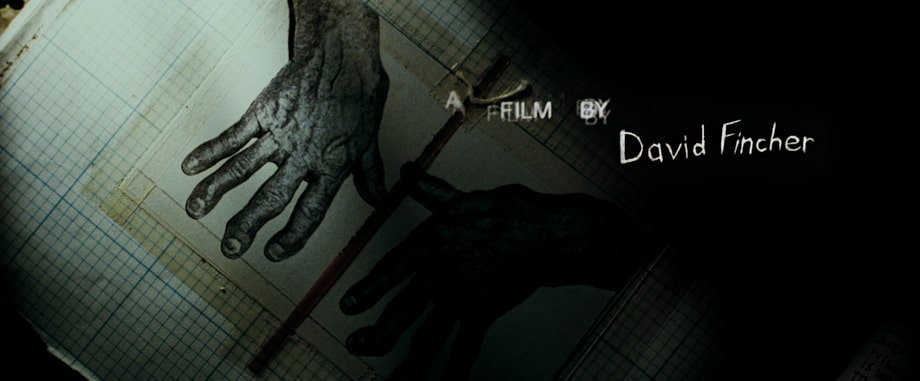
It won’t be an overestimation to say that the opening credits in David Fincher’s movies are a separate kind of cinematic art. One would say that it should come as no surprise since David Fincher became in demand as a creator of music clips, but very few music videos or commercials look like and feel like the opening scenes in ‘Seven’ or ‘The Girl With the Dragon Tattoo.’ The point here is that the opening credits in Seven are extremely tightly connected with the upcoming movie, and you should rewatch them to see how little detail they reveal, though they are not so informative during the first watch. An interesting detail here is that the credits come only four minutes into the story after introducing the two main characters with an obvious focus on Detective Somerset, the key protagonist played by Morgan Freeman. The first minutes of Seven show the level of apathy and indifference for this character, who has made crime scenes his daily routine, and the following stylish credits work on this initial impression.
Getting back to the information about the murderer revealed in the credits, both very informative and non-decisive:
The main antagonist cut the touch balls on his fingers to erase his fingerprint identity rather than just using gloves.
He (John Doe) wrote numerous notebooks with ugly pictures, frightening sketches, and files on other people and his potential victims. He has a lot of free time.
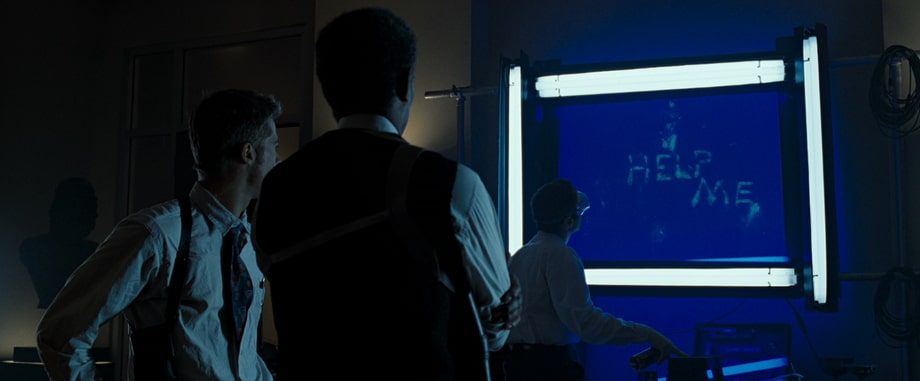
The opening credits spoil us that the serial killer is a photographer, or at least he uses photographs in his murders and has a darkroom.
John Doe examines tonnes of information to educate himself before the killing, but he focuses on some pieces of information on a selective basis and strikes through the information he does not need or wants to ignore.
He studied the history of crime scenes and old murders to become an effective murderer.
The antagonist has a complex relationship with religion since we see that he cuts the word ‘God’ from a dollar banknote and then burns it. This symbolizes the fact that John Doe lost his faith in God, or, which is more grim, he thought of himself as a God, an entity who punishes people for their sins.
David Fincher once said that with the opening credits in Seven, he wanted the audience to feel uncomfortable from the beginning by giving people a feeling of how dark and brutal the movie would be. What can be more effective than showing us the mindset of the serial killer, who meticulously prepares to take the lives of other people in the most frightening forms? We see no murder process in the credits, but only preparations, and showing the notebooks of a mass killer and a madman creates a rising feeling of discomfort. John Doe is a photographer, and the visual style of the credits renders this fact and gives the feeling that they were created in the darkroom of a madman.
The Seven cinematography style in this scene is intensified with the disturbing soundtrack by ‘Nine Inch Nails’ and particularly by Trent Reznor, who would collaborate with David Fincher on The Social Network, The Girl with the Dragon Tattoo, Gone Girl, and Mank. The soundtrack intensifies the visual narration and provokes discomfort as early as the fifth minute of the whole story. The other important detail that should be mentioned when dealing with the Seven opening credits is the well-known omission of Kevin Spacey as an actor. The film creators wanted the audience to be surprised by the real identity of the murderer, and they succeeded.
SEVEN LEVELS OF HELL: A NAMELESS CITY
Ask even the frequent viewers of David Fincher’s Seven about the place where the story takes place, and most of them would name New York. Nameless gray residential houses, dark alleys, office skyscrapers, depressing police stations, and a never-ending rain. Despite all cinematic references and associations, the city’s name is never mentioned, and, if it wasn’t enough, every scene of Seven was filmed in Los Angeles. Leaving aside the practical considerations of production, David Fincher wanted to show LA from an unorthodox perspective by turning the city conventionally associated with sun and beaches into a grim rainy megapolis drowned in violence and apathy. Such an intended contrast worked well to create a general atmosphere and a feeling of failed expectations. Cinematographer Darius Khondji recalled in one of his interviews that some locations in Los Angeles were too realistic, with syringes and used condoms, that the filming crew had to clear them to some extent to fit the movie’s needs.
The city in Seven provokes disturbing references to a modern version of a biblical Gamora, at least from the perspective of a serial killer, John Doe, and police detectives who chase murderers, and these two angles are what we have. The city in the movie feels like it lacks space by making its citizens live in suffocating, dark, and squalid apartments in poorly lit, dirty tenement houses. Even Detective Mills and his wife Tracy, found themselves renting a miserable house that is being shaken to its foundations by every passing metro train. They try to hide a bitter dissatisfaction with jokes, but this brings poor relief. This little detail regarding Mills’ house is worth attention, not solely because of the city’s urban development condition. The couple recalls a tricky agent who took advantage of them, people from other cities who did not know the details of the local transport system. Even before the main story began, the Mills family felt the rottenness of people in the unnamed city. When Mills (Brad Pitt) goes for a job, he can see citizens eating bad food in poorly lit cafes and visiting dirty nightclubs. More than that, even though the choice of the victims was a part of the mindset of a mad serial killer, Mills now has to perceive the city through the ugly sins. In an intimate discussion with Detective Somerset, Tracy Mills admits that she hates the city.
John Doe, whose real name is never revealed throughout the story, reminds us of the grim version of an iconic-like Travis Bickle from ‘Taxi Driver’ by Martin Scorsese. At the time when Robert De Niro’s character was an antihero at his maximum, John Doe was a real villain who deserved neither compassion nor understanding. David Fincher and the scriptwriter Andrew Kevin Walker created the real monster, allowing for no appeal, a fatal, unstoppable force. For years, he intoxicated himself with the image of the sins of people around him, but his mental state distorted the city to an extreme extent. It should come as no surprise that John Doe regarded the unnamed city as Dante’s hell, which he has meticulously described in his notes for years. The city was a dirty and dangerous place, but the serial killer turned it into a nightmare. Speaking about further references, in 1999, the creators of ‘The Bone Collector’ derived inspiration from David Fincher’s masterpiece, though placing the events in New York, which looked as grim as the unnamed city from Seven.
One of the details of the unorthodox Seven cinematography lies in the color palette of the city. The creators intentionally avoided the usual colors associated with Los Angeles and desaturated their locations. The lack of vivid colors was used to show the decay of the city and the dehumanization of its citizens toward each other. More than that, cinematographer Darius Khondji and director David Fincher created what is usually referred to as ‘cold exteriors and warm interiors’ when showing the unnamed city in Seven. If we carefully take every exterior panorama of the city before John Doe’s intended capitulation, it is not only raining, which itself brings a cold palette, but the office buildings and tenement houses are shown in blue colors, cold and lonely. We are presented with the image of a modern megapolis, which has outgrown its capacity to unite people, protect them, and make them feel happy. Like millions of families before them, Mills came to this megapolis from a smaller town in anticipation of the American dream, and instead of them, they hate the city, and the city hates its people. That’s how the Seven Movie Cinematography works perfectly in creating one of the most depressing exteriors in movie history.
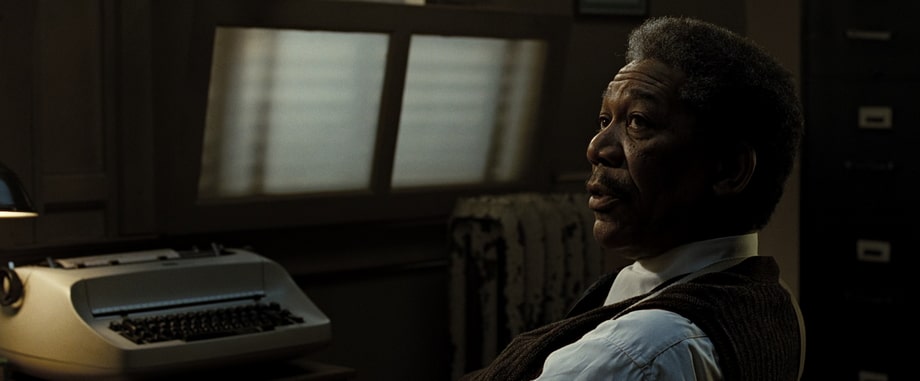
While many regard a young detective, Mills, played by Brad Pitt, as the key protagonist, it is a mature detective, Somerset, through whose perspective we see the story. The very first scene of the movie shows us Morgan Freeman’s character at his home during his morning routine. No police chases, no investigation of a crime scene yet, no other detective, and no Brad Pitt. Only an elderly police detective who is one step from retirement. The emptiness of Somerset’s look has always reminded me of the evolution of Allis Boyd ‘Red’ Redding played by Freeman in The Shawshank Redemption, when his enthusiasm for leaving the prison vanished over the years. Detective Somerset has probably experienced the same decay in his world and hated the city that had once promised to protect him. He is the second character reference to Travis Bickle, though, who managed to remain a human being. It is reasonable to say that Somerset has also gone through a process of dehumanization similar to the city around him. During the first crime scene, he is seen as emotionless, apathetic, and unsympathetic, as he probably perceives people as either criminals, victims, or bystanders. He later reveals that retirement also means his departure from this ugly city, the motive that will be changed only at the very end. For years, Somerset has pushed away other people, a potential family, an aborted child, and his colleagues, and his life serves as a vivid example of a lonely person in a city with millions of souls.
Another cinematographical craft that Seven uses is avoiding the direct violence on the screen. None of the murders performed by John Doe were shown in the movie; we only see the consequences. The movie does not need flashbacks or other visual techniques to show the process of work of a serial killer. Even in the final scene, the audience does not see Tracy’s head in the box, thus making the famous ‘what’s in the box’ scene so powerful. One would argue that we have the scene of the chase where Mills hurts his hand and John Doe menaces him with a gun. Mills suffered accidentally, and the serial killer never intended to kill him. Speaking about the impact on the overall story, showing the crime scenes only ex-post, thus makes them unavoidable. It intensified the depressing atmosphere in Seven that police detectives are always several steps behind the killer and that they can’t stop his cruel crusade of murders. David Fincher did not show us what is in the box since the understanding of its content works even more powerfully while focusing on the actors’ performances. Even when Detective Mills shoots John Doe in the head, the moment does not exploit the violence and is shown from a distance.
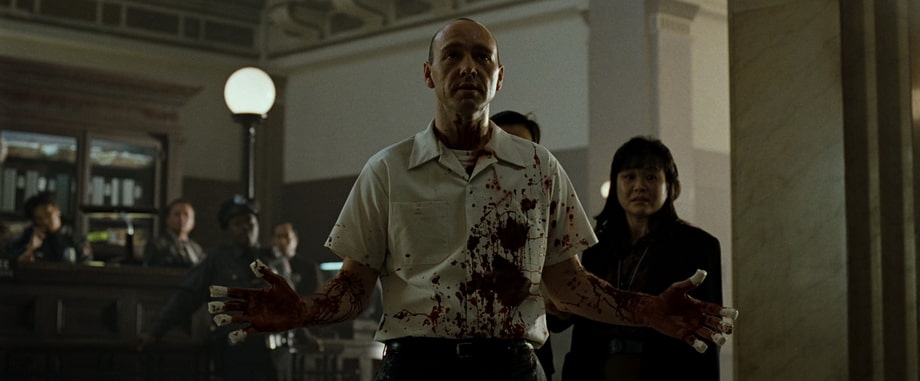
It is peculiar to note that constant rain was not a decided cinematographical element in Seven at the stage of script writing or pre-production. The winter of 1994/1995 was rainy in Los Angeles, and starting in December, the filming crew faced new exterior realities. Neither David Fincher nor cinematographer Darius Khondji wanted their city to look sunny and Californian, so they turned the rain into a part of the story and an important element in creating a depressing neo-noir atmosphere. On the level of perception, the never-ending rain symbolized the warmth and compassion being washed out of the city. On a cinematographical level, it helped to create a cold blue color palette for the exterior shots of the city. On the story level, rain makes Somerset, Mills, and Tracy hate the city even more and helps John Doe to stay in the shadow and metaphorically ‘wash out’ his traces. It is never mentioned, but probably Mills (Brad Pitt) and Tracy came from a more pleasant location, and the never-ending rain here does not make good. The rain suddenly comes to an end when John Doe (Kevin Spacey) surrenders himself, which creates the false feeling of the upcoming happy end and safety for the city’s citizens, as well as the triumph of the two detectives. The vanished clouds also symbolize that the mystery is gone, and we finally know the face of a killer. In the end, the sunny weather intensified the shock in the defining sequence.
THE DARKEST SHADOWS
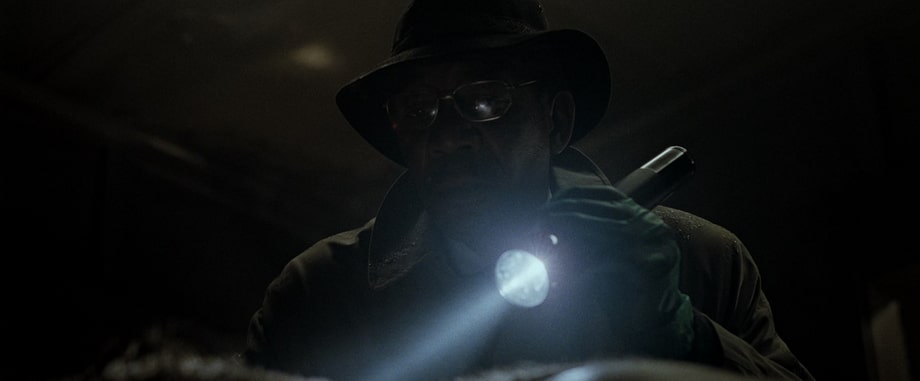
In my previous article devoted to David Fincher’s movies, Gone Girl, I spoke about the technique that is usually regarded as ‘dark clarity’, which Fincher is well known for since Alien 3, Seven, and throughout all his following works. The point here is that the scenes in Seven are not just dark with crushed blacks like in many horror movies of dubious quality. The magic here lies in lowering the highlights, using the unique color palette for them while preserving details in the shadows with high-contrast black color. As both Fincher and his cinematographer Darius Khondji later admitted, the lighting in Seven was a hell of a job, especially while working on dark, poorly lit locations. Both creators are known for using the so-called ‘motivated light’ in their visual narration. In Seven, we rarely see several sources of light at once, and most of the locations are lit with one primary lamp, or window, or the same kind of source multiplied, like the scene with Detective Somerset in the library with desk lamps with green bell glass. By eliminating the feeling of the usage of artificial cinematic light, the creators intensified a feeling of presence and a depressing environment.
Let’s take the opening scene with Detective Somerset (Morgan Freeman) in his apartment. We see only two sources of light; each works on its own and with its own purpose. The movie opens with a view of our main character from his back while standing next to the window. Depressed highlights from the window, combined with a cold blue color, create an impression of coldness outside. Then we see Somerset deeper in his house, with light coming from a reading lamp with a warm yellow palette. These two tiny details give tone to the whole movie. Getting back to my previous description of the color palette used in the panoramic scene showing the city, Seven cinematography makes the exteriors look cold and lonely, and after getting inside, characters are usually welcomed by a warm color palette, thus creating a vivid contrast. For one and a half hours, this rule works until John Doe comes to the detective and surrenders. Starting from this moment, the outdoors looks sunny and yellow, which creates a false feeling of safety and the upcoming happy ending. The movie plays with the audience’s expectations to shock us in the ‘what’s in the box’ scene.
Even without the final sequence, the feeling that the interiors are safe is, of course, false. We see no crime scenes outdoors, and while the city looks cold and unfriendly, all the horrors before the final sequence are located indoors. We see poorly lit crime scenes with a mix of cold blue, warm yellow, red, and green color palettes, and they are horrible. In some scenes, the cold daylight breaks into the interior, thus making a cinematic intrusion. The other secret of cinematography in Seven, when dealing with limited ‘motivated light’, is using shiny surfaces like linoleum and walls to spread the light and colors. Darius Khondji revealed in an interview that in Seven, they worked a lot with different surfaces to get the intended effect. For example, they used water to make the floor look reflective and shiny, and the choice of locations was often motivated by the surfaces and the color of the walls. When needed, they used paintwork and lacquer to make the surface look appropriate to the scene. The filming crew often used Chinese lanterns for lighting the scenes.
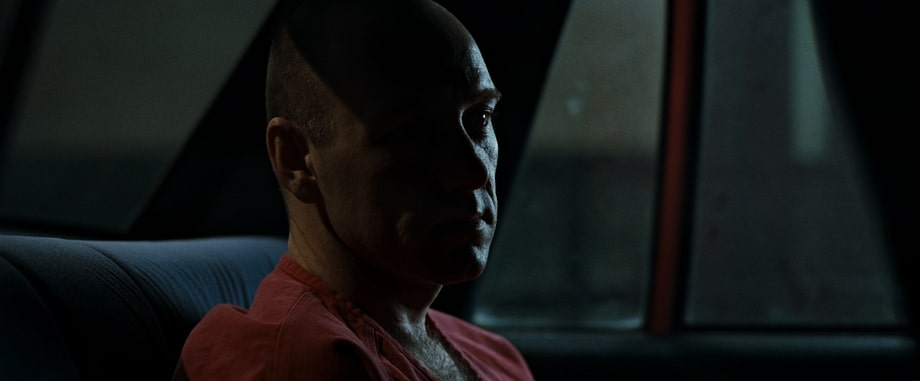
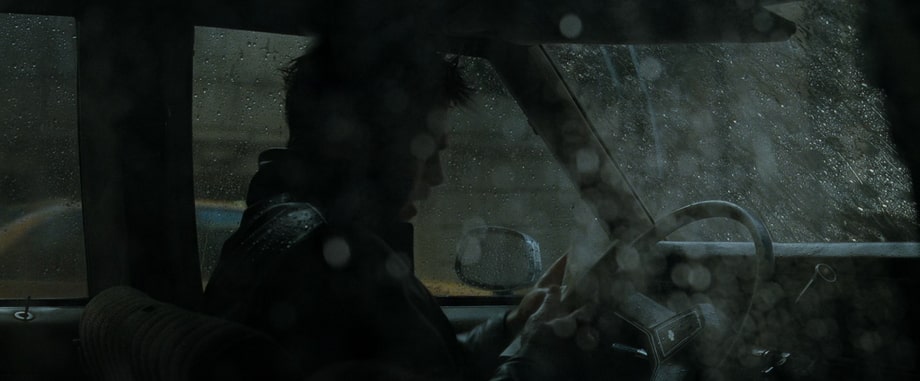
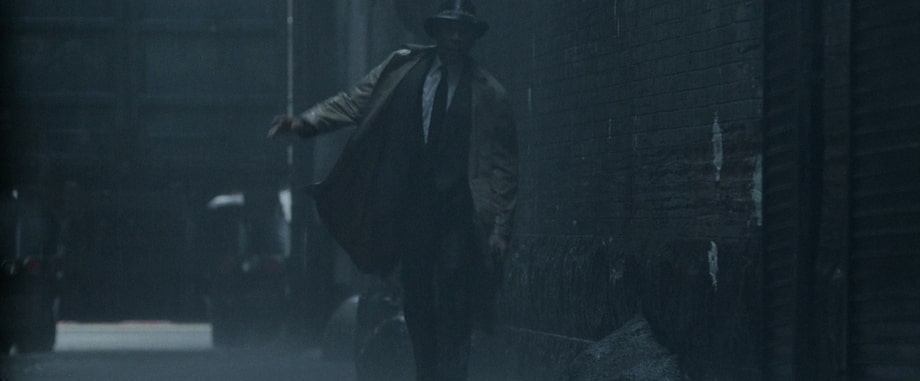
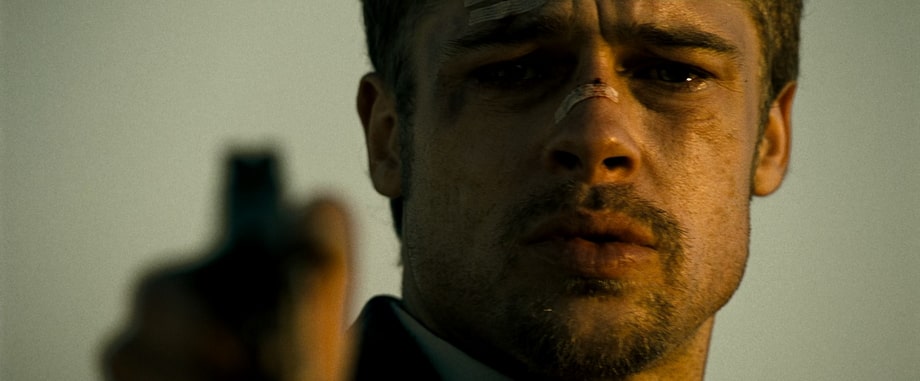
It’s interesting to mention that not only does the interior scene use dark clarity, but most of the scenes with characters inside the car use depressed highlights in the vehicle, while the exteriors are bright, especially during the final ride with John Doe in the back seat. The famous chase scene was an additional challenge to the filming crew, even compared to the overall meticulous approach with lighting and colors. The crew had to shoot sequences of action in poorly lit corridors, hallways, stairways, and alleys. It demanded much more preparatory work with the sources of light and reflecting surfaces. More than that, the final part of the chase scene happened outside under the heavy rain. Most of the chase sequences showed Somerset, Mills, and John Doe only as poorly lit silhouettes. Several shots were so dark that Fincher and Darius Khondji had to reshoot them. In this vein, even the dark clarity of David Fincher could sometimes be too dark and with not enough clarity. As a cherry on the cake, the film creators used a specific chemical process applied to the Seven film stock, which deepened the shadows and created an effect of a limited dynamic range. The culmination in the field used low light levels even during a sunny day, when the faces of characters are half-lit by using specific angles with an accent on backlit. Above all, most of the movie was shot ‘wide-open’ using a widescreen composition with a narrow range of what the audience should focus their attention on. All these techniques made Seven look unique and more like a photographic print than a high-budget Hollywood movie.
Detailed movie and psychological analysis of the Good Will Hunting movie and defining the protagonist by means of his social environment: Sean, professor Lambeau, Skylar, Chuckie and his friends
National Lampoon’s European Vacation has made its place in history as one of the best travel movies, and this time they came to blend in the crowd of French people in Paris.
Pirates of Silicon Valley has become famous as the Steve Jobs and Bill Gates movie, which tells the story of two profound visionaries of the digital era.
A Million Dollar Baby story of Maggie Fitzgerald and her dream of becoming a boxing champion should be studied in the context of child-parent relation with her trainer, Frankie Dunn
The opening five-minute sequence of the Skyfall movie takes us on a memorable journey across the street of Istanbul. Let us find every Skyfal Istanbul location
Blade II was one of the first Hollywood projects set its production in the city of Prague in the early 2000s and several locations are still accessible and slightly changed after two decades












 5,00
5,00