Denis Villeneuve’s memorable directorial work, Sicario, is widely regarded for its superb cinematography, evidently thanks to an iconic cinematographer, Roger Deakins
In just a little over one decade since the ‘Prisoners’ (2013), Denis Villeneuve has established himself as a masterful creator with his directorial style. His movies are dark and often explore complex or even dubious characters. They look perfect from the cinematic point of view, they often sound disturbing, and leave us thinking about what has just happened. Like Christopher Nolan, David Fincher, or Wes Anderson, Villeneuve does not shy away from being a consistent artist who repeats his tricks from one project to another, but we are still fascinated and willingly join his cinematic journeys, from the dark basements in Pennsylvania to the scorched sands of Arrakis. In this article, I will research the cinematography of Sicario from the wide-angle view of Denis Villeneuve’s directorial vision, Roger Deakins’ mastery as a cinematographer, Johan Johannson’s disturbing soundtrack, and the actors’ mastery of Emily Blunt, Benicio del Toro, and Josh Brolin. As a result, they made the most of the script by Taylor Sheridan, one of the most talented writers of our time, particularly in terms of character development, dialogue, and immersion into his worlds.
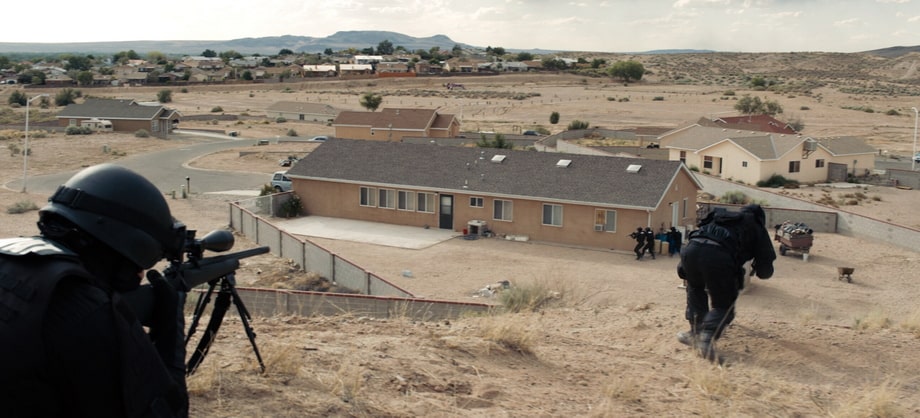
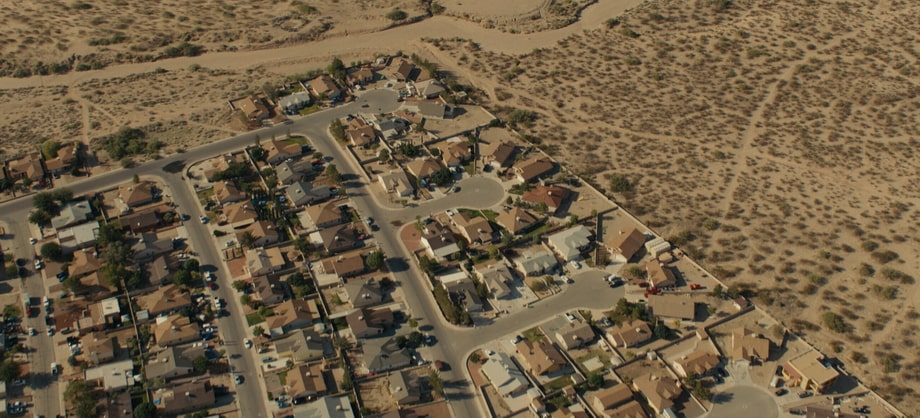
The general wisdom says that there are few approaches in cinema that keep the audience more engaged than suspense. Sicario masterfully exploits this feeling of intense anticipation to the full, starting from the opening scene. The movie opens with a casual, non-threatening landscape of the Southern USA with houses, cars, and trees. Put in another context, this panorama could have started a family drama or comedy. What distinguishes the scene is the introduction of a disturbing musical background, or more accurately, a sound design, and the appearance of armed individuals entering the frame. Johan Johannson’s alarming music shapes the restless and anxious mood of the scene even before the opening shots, starting from the credits. We anticipate the violence on screen, and only two minutes into the movie, a large armoured car of a special squad squashes the wall of a secluded mansion. The context and the appearance of people inside the house make no surprise from the upcoming gunfight, but the action scene by itself was not the cinematic point of the opening sequence.
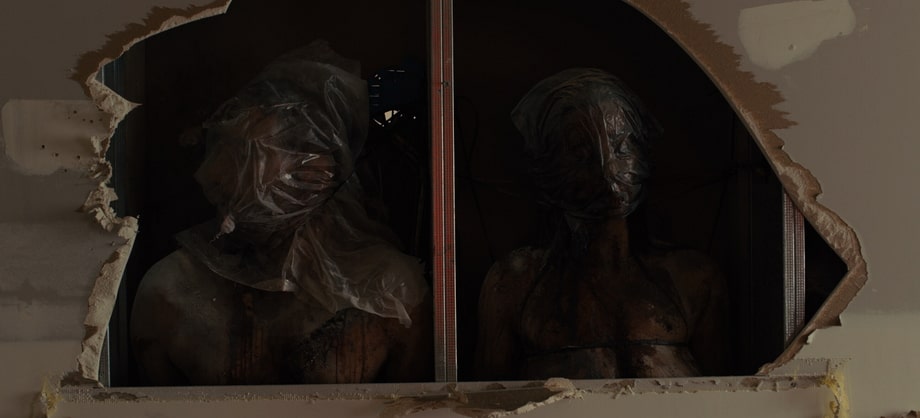
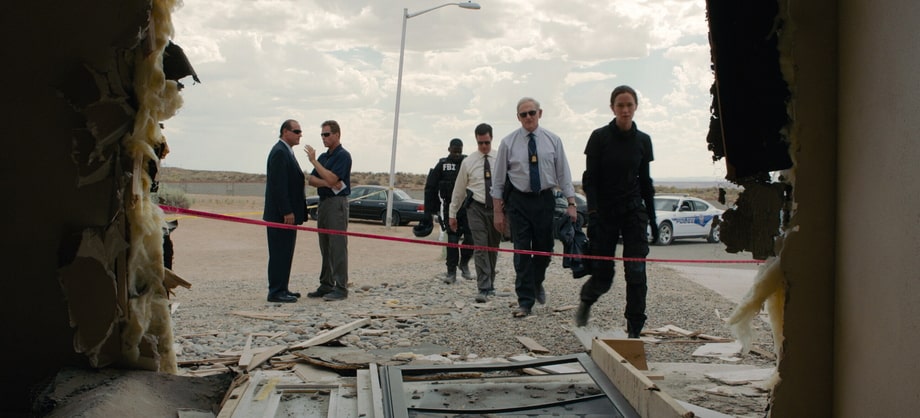
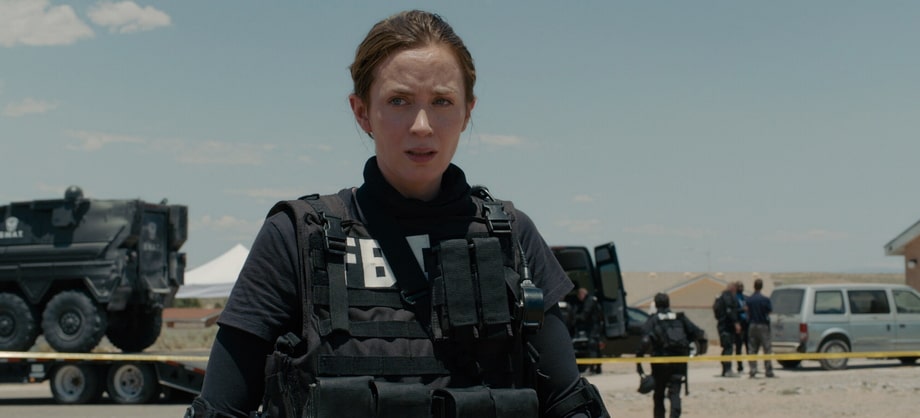
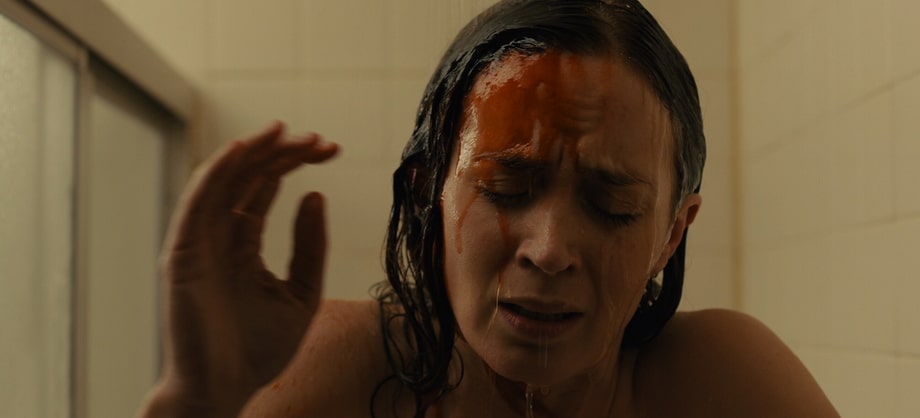
What makes this opening scene great is the continuation of the tense anticipation even after the last bad guy was killed. The restless sound background does not stop with the last shot, and Emily Blunt’s team reveals dozens of bodies hidden in the walls. This finding petrifies the audience, especially thanks to the contrast with the peaceful appearance of the house and its surroundings, integrated into a casual, boring landscape of the American heartland. Even though we supposedly came to the climax of the scene, the soundtrack and the overall feeling of anxiety do not stop. Maybe there are other horrifying findings in the basement that we have not seen yet? A few moments later, a powerful explosion kills at least two policemen, devastates half of the area, and leaves the protagonist character astonished. We had previously received a hint that the two men should not attempt to reveal all the secrets of a nearby shed, but the explosion caught us by surprise. The pulsing soundtrack stops only by making way for a contrast scene with Emily Blunt’s character in the shower. Overall, these six opening minutes set a tone for the whole two-hour movie.
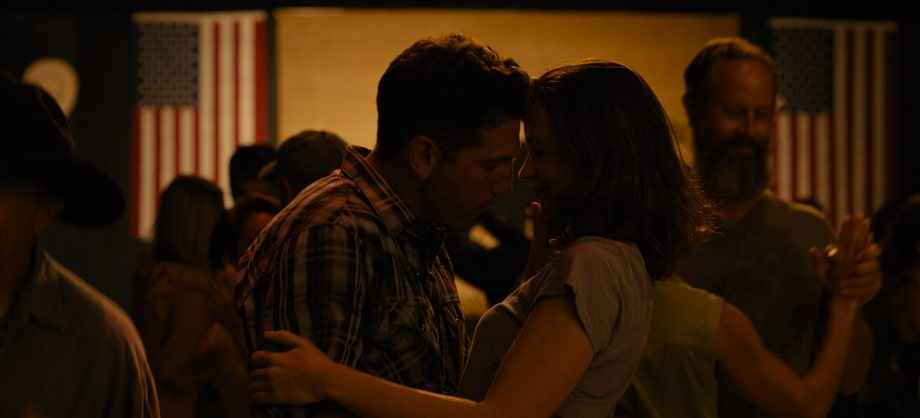
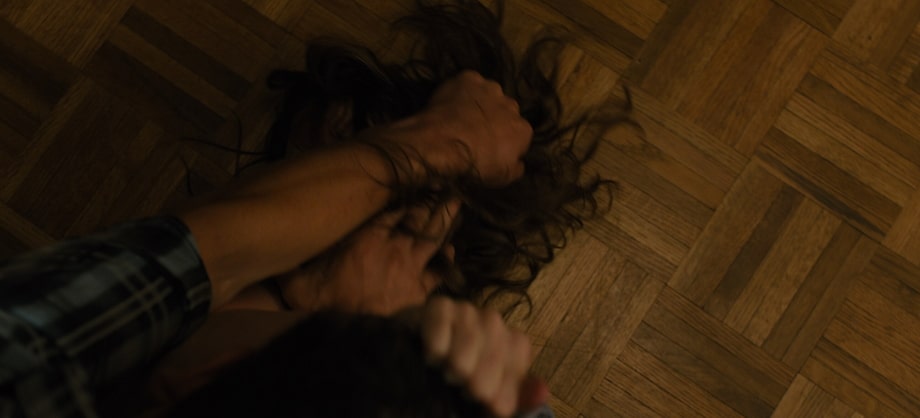
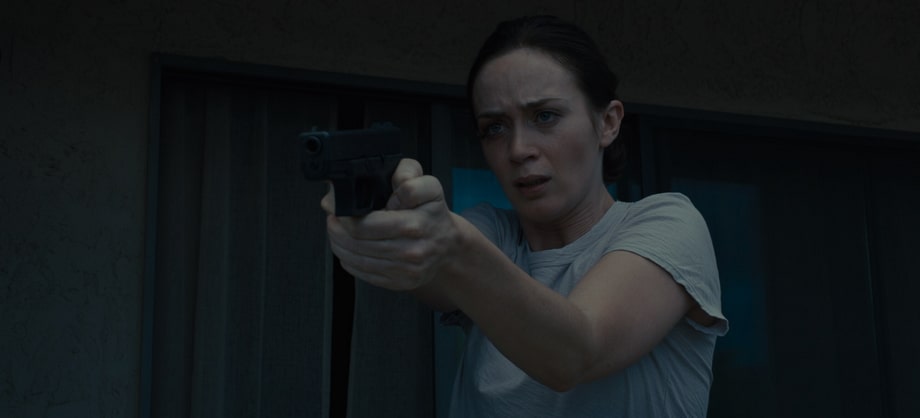
I am not going to analyze every tense scene in Sicario in the same way, but what makes this movie excellent is a mix of tense scenes and calmer dialogues, playing a contrast, but the overall feeling is one of uncertainty. Since the main character, Kate Macer, was kept in the darkness for most of the story, the classic feeling of intense anticipation does not go away even in the casual dialogue scenes. The movie constantly breaks into our comfort zone once we think that it is time to relax for a while. Kate went to the roof and smoked a calming cigarette. A few moments later, another agent shows her the alarming background on the other side of the Mexican border, with gunfights and death. We calmed down when Kate took her time in a bar and met a good guy, also from the police. A few moments later, she points her gun at him, and he nearly strangled her to death. Even when Kate watches as Benicio del Toro’s character is sleeping, he suddenly wakes up, probably after a nightmare. Sicario sets a disturbing tone starting with the opening credits and takes us on this journey of suspense to the final shot.
THE DARK CORNERS OF AMERICA
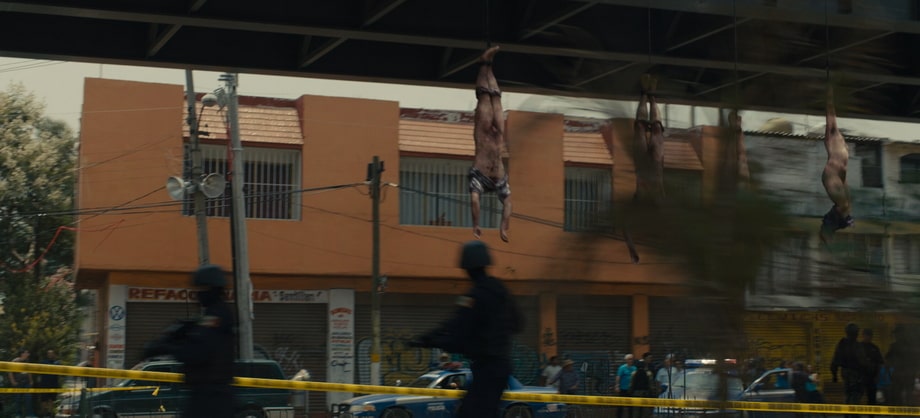
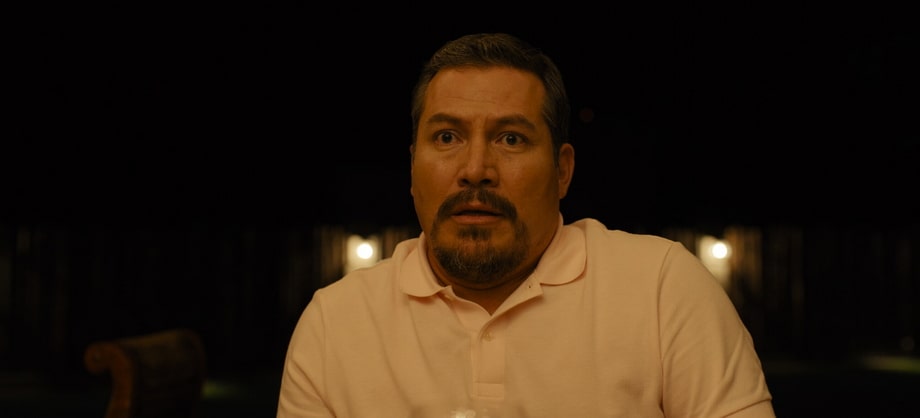
Sicario got a rating R for ‘strong violence and language but the movie never exploits or romanticizes this violence on screen. Staring from the opening scene, we do not see explicit details during the gunshots, fighting, or even torture. When the special squad reveals dozens of bodies behind the walls, the work of cameraman Roger Deakinns, the disturbing soundtrack of Johan Johannson, and the acting of Emily Blunt, Josh Brolin, and Benicio del Toro all work perfectly in the creation of a horrifying feeling. Sicario does not need closer shots of guts or blood to impress its audience. After the explosion, we do not see the remains of the bodies of the two policemen. The torture with water was not even seen when the camera moves away, and all we see is a sewer hatch. The movie shows us dead bodies hanging on the streets, but we do not see the process of killing. Even toward the end, when Benicio del Toro’s character kills the whole family of a drug king, we perceive the scene through the lack of facial expression from Alejandro and the horror on the face of the father. When Matt Graver reveals to Kate the horrific fate of Alejandro’s family, his wife and daughter, he does not need to show her photos, since the previous one and a half hour has formed our perception of this cruel world.
It is worth noting that any movie creates its own cinematic universe, and Denis Villeneuve’s Sicario never pretends to be ‘based on a true story’. In this vein, the critic branding the movie for an inappropriate and exaggerated image of Mexican people or the situation across the border makes little sense. In a wider sense, you do not even need to be an American citizen to be captivated by the Sicario’s story, since its story communicates with the audience on universal topics of human violence, rivalry, greed, and institutionalized measures. For example, Matt Graver (Josh Brolin), despite his sharp words, has no racial prejudice against his target or enemies. He targets them, he tortures them, he exploits Kate, uses Alejandro, and other people, not because of the hatred, or racial segregation, or arrogance. His methods are cruel and lack principles, but he acts according to the orders and the overall goal of coping with the drug traffic. Guillermo Diaz becomes a target since he is involved in the drug contraband and may serve as an instrument for a larger purpose of identifying the location of the cartel king. The local Texas police officer becomes an enemy of Kate, since she reveals his collaboration with the criminals.
Getting back to the methods of creating suspense in Sicario, the movie masterfully exploits the topics of drug trafficking, illegal immigration, corrupt police, and CIA methods to keep us in constant tension. Several important scenes take place at night, but a few at daytime, so the movie does not need darkness to put additional pressure on its audience. As I said above, Villeneuve and his filming crew created a whole new cinematic world, a terrifying and disturbing place, where you wouldn’t want to find yourself. The feeling of anxiety is intensified by the protagonist, Kate. On the one hand, she is a member of a squad team that fights with the drug dealers day after day, and who reveals dead bodies inside the walls. On the other hand, the events of the main story become too much even for her, as well as for the audience. Like Graver and Alejandro admit, Kate does not belong to this world, or better to say, she can’t stand the methods that allow one to gain success in this world. The dividing line between the cruelty and the targeted violence vanished.
BREATHTAKING SHOTS BY ROGER DEAKINS
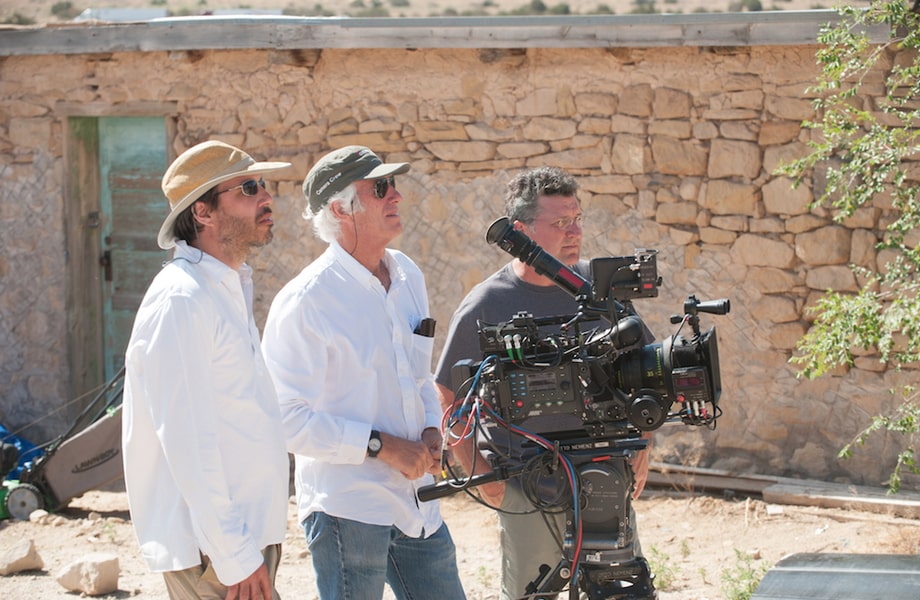
The short story here is that Roger Deakingsis is probably the most acclaimed cinematographer in history. He was nominated for an Oscar sixteen times, of which he won two golden statues. His cooperation with Denis Villeneuve brought to the world three movies: Prisoners, Sicario, and Blade Runner 2049. Deakins won an Oscar for the latter one and nominations for both previous ones. In a wider sense, Sicario was not only directed by one of the brightest filmmakers of our time, but was masterfully staged by a genius cinematographer, whose work here (Sicario cinematography) got universal acclaim. Three movie made together with Villeneuve made their cooperation the third most intense in Deakins’ career, after an incredible eleven movies with the Coen brothers and five cooperations with Sam Mendes, including the Oscar-winning cinematography work on ‘1917’. He is known for meticulously detailed preparation for every work, and Deakins’ techniques differ depending on the movie, but there are several key approaches, which he implements in most of his works and which are palpable in Sicario cinematography.
CUTTING THE FRAME AND COMPOSITION
Even though his precise methods may differ from one movie to another, what remains firm is Roger Deakins’ mastery of choosing an effective frame composition. Like in photography, what you put in your frame (background, objects, characters) defines what kind of information you tell your audience. Many people argue that the composition and framing are the most important factors in cinematography, and taking a closer look at Deakins’ works, particularly Sicario, leaves a few doubts about the fairness of such a claim. In a general sense, any cinematographer creates an architecture of things or characters in the frame, which helps to focus the audience’s attention on certain objects, events, or even the between-the-line senses. If you put the meaningless objects in your frame, you degrade the cinematic narration, and to the contrary, a perfect frame composition may serve a storyteller even without a single word said.
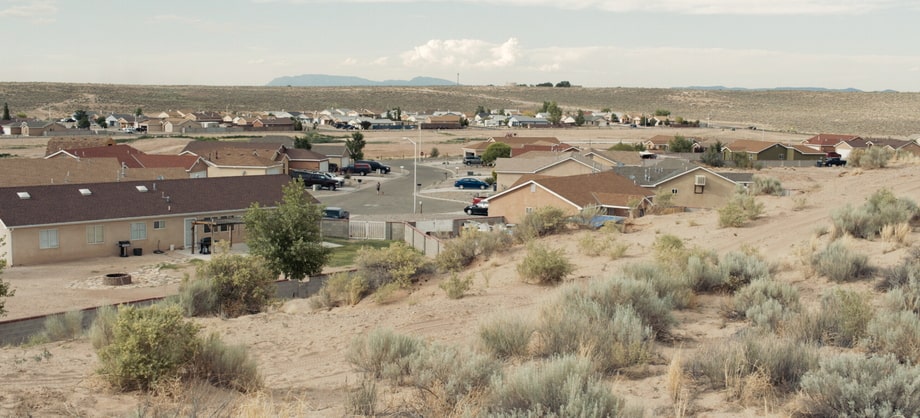
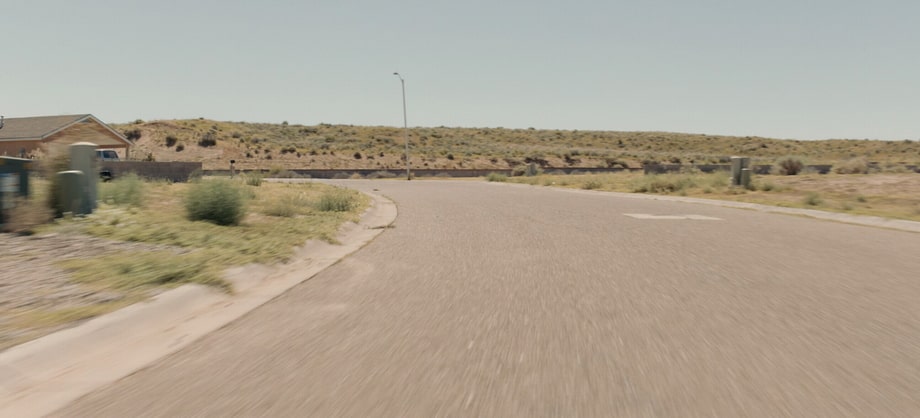
Getting closer to the Sicario cinematography, Deakins’ approach does not mean making frames narrow with a domination of close shots. Instead, he uses a minimum of visual information in often wide shots and panoramas. What ideally works in Sicario is using wide or even extremely wide shots and putting the characters inside this alien environment. We get the perception of the place and people, often intensified by the previously mentioned disturbing soundtrack. Taking the opening sequence, what we see first is a vast panorama of an American South neighborhood with the same-type houses lost amid the never-ending desert on the horizon. The cameraman stands on the hill and shows miles of terrain, with a woman walking with her dog in the background. Nevertheless, the frame does not convey much visual information, and despite the depth of the background, our attention is focused on one of the houses. Deakins uses a police squad unit to direct our attention. One soldier is moving toward the building, and if we continue his line of movement, it strikes the house, while the second one on the left is aiming at the target with his rifle with an optical sight. The frame literally squeezes our focus on the mansion.
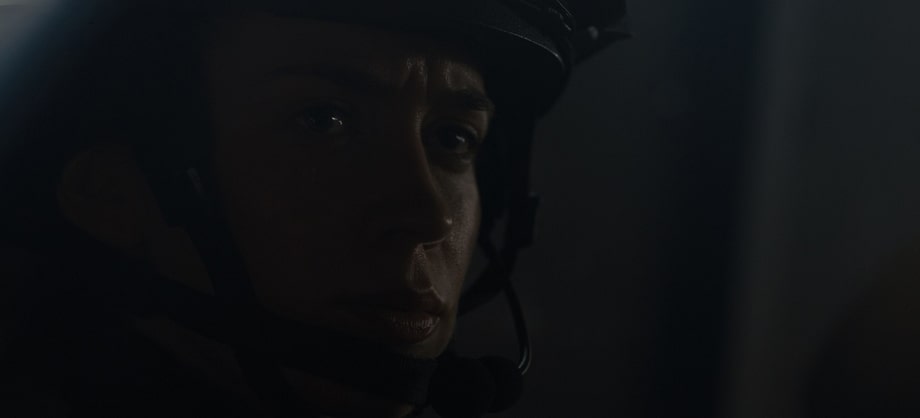
What we see next is a series of close shots inside the building and of Kate (Emily Blunt). For a moment, we do not clearly understand whether she is inside the mansion or elsewhere, and when the camera moves away from her face, we see the protagonist character inside the environment. She is a woman among half a dozen men of a special squad, who ride inside the armored car, probably toward the previously shown house. Then we see the mansion, but this time not from the wide perspective of a hill, but from a close shot of the road beneath the wheels. The following gunshot scene focuses our attention on the interior of the creepy house, the characters’ reaction, and the horrifying revelation in the walls. Deakins actively uses the doorways, windows, and even the holes in the walls to frame our focus of attention for the next five minutes. Wide panoramas don’t come back until the whole sequence is over.
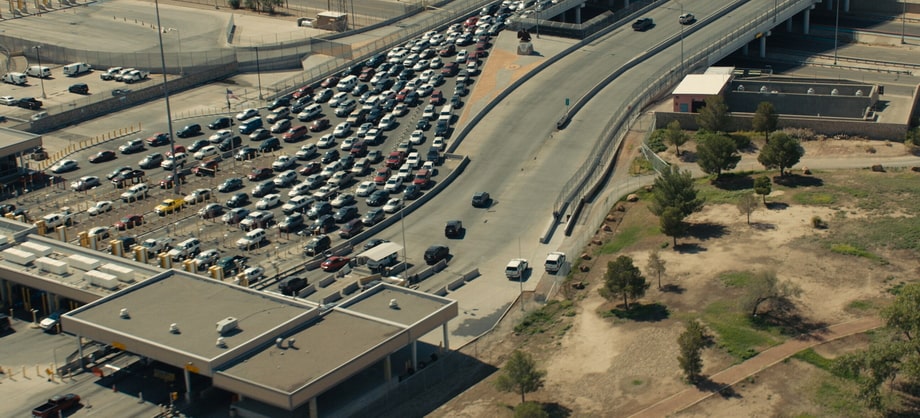
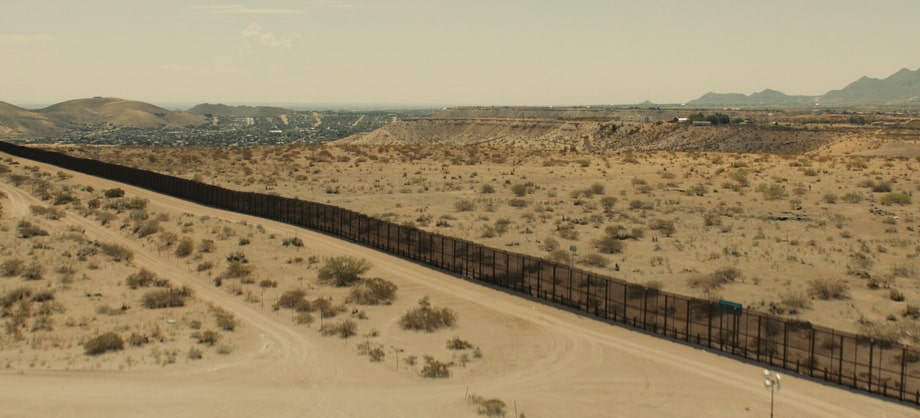
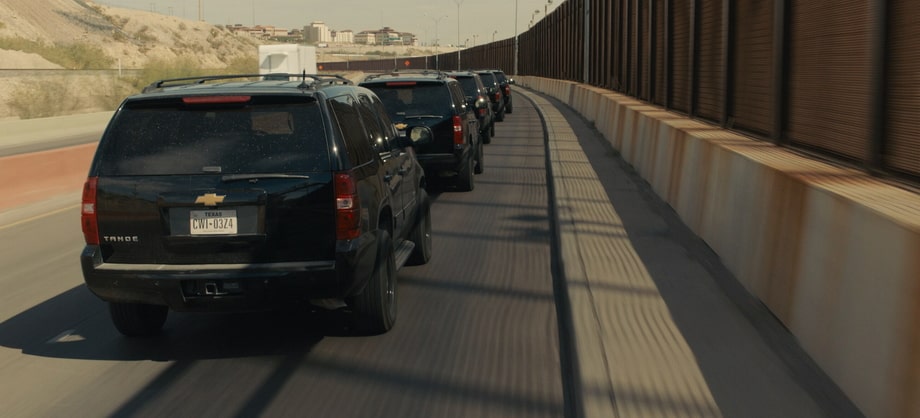
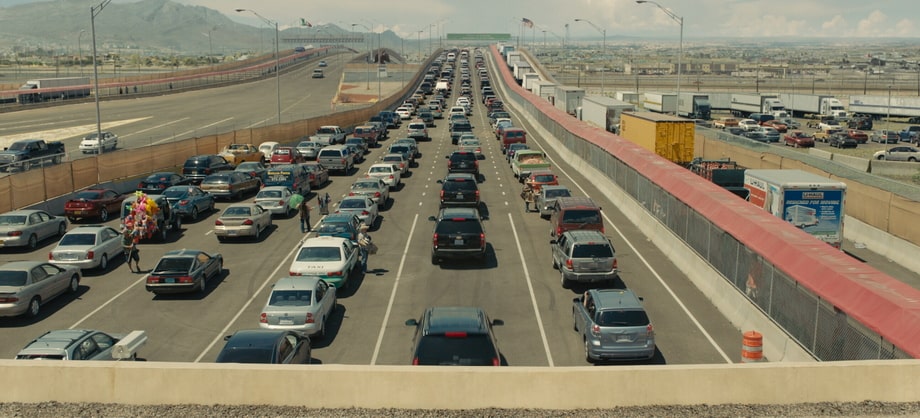
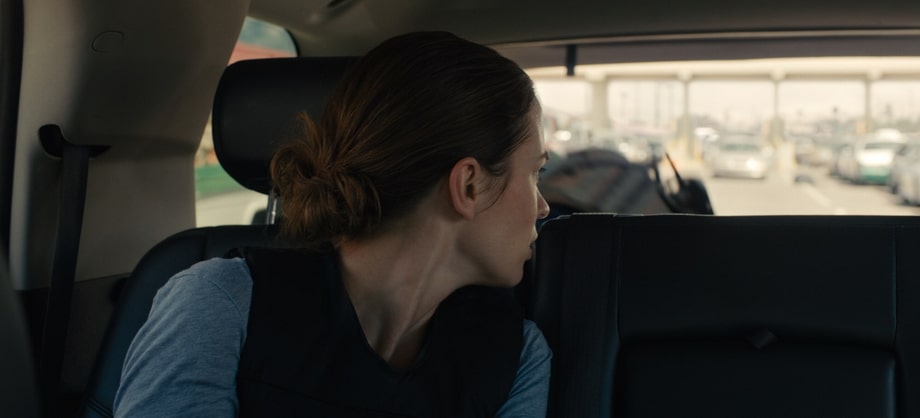
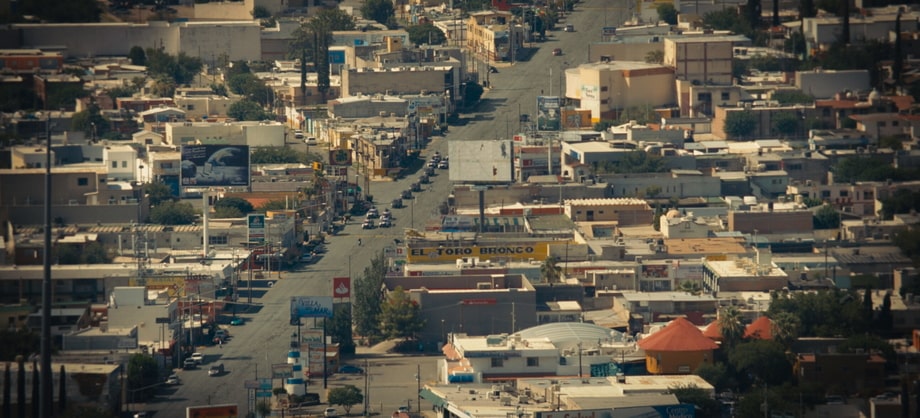
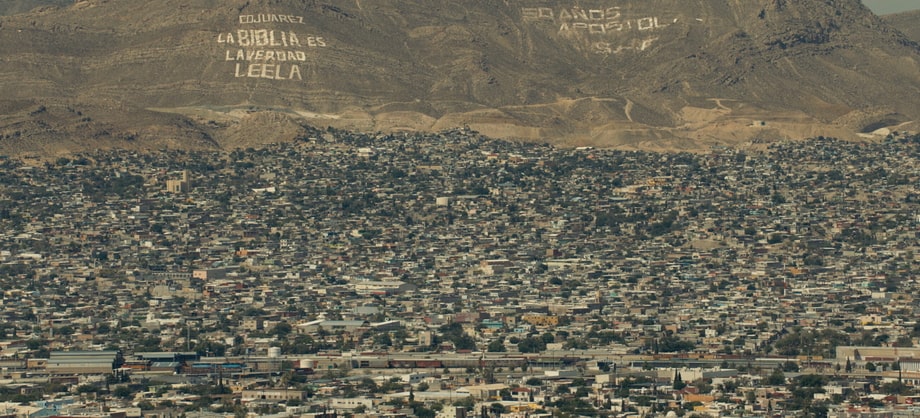
Any Sicario cinematography analysis would be incomplete without mentioning the raid mission scene and the breathtaking panoramas of the Mexican-American border after minute 24. Deakins focuses on wide shots with a wasteland on both sides, but the lack of visual information in the frame leaves the audience wondering how insecure such kind of a wall may be, taking into consideration its length. We see that even a canyon was not left as a natural barrier between the two countries. In this sequence, the framing often splits the screen into two parts, either horizontally or vertically, and creates a feeling of loneliness and insecurity. Another thought that we may come to is the understanding that there is no significant difference between the two terrains. The Mexican territory looks pretty much the same as the American part of the border, which reminds us of the relativity of the borders based on political matters. When the transport column with three main characters (Kate, Alejandro, and Matt) crossed the checkpoint, the framing splits the view into two parts, with a few cars going to Mexico and hundreds waiting for an entry pass to the United States.
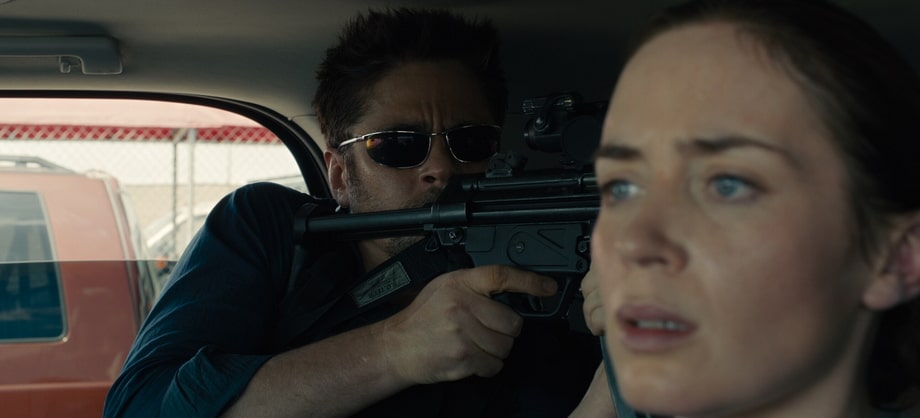
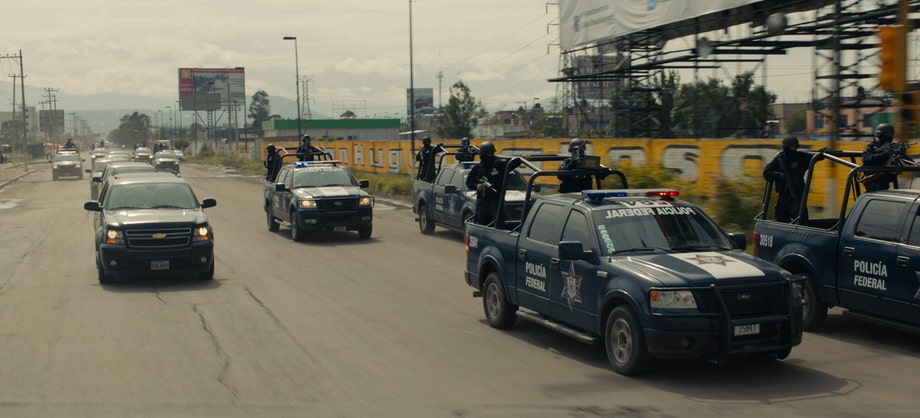
While characters got to the destination point without accidents, the suspense efforts did not go away, and the movie provokes our feelings of disturbance and uncertainty on the way back. The famous and recognizable gunshot scene on the lane was crafted as a combination of just a few panoramic shots of the road and close perspectives, which creates a claustrophobic feeling of close combat with automatic subguns instead of ancient swords. Later on, Kate bursts with anger regarding the dangerously close distance between the Delta squad and their targets on the one hand, and casual travelers in their cars on the other. Deakins’ close shorts also underline the casualness of the mission for Matt and his team, who can make a gunshot among hundreds of witnesses, and the consequences will never find their way even to the local news. Another aspect of this fighting at close quarters is Kate’s reaction, who used to lead assault groups in a controlled and well-prepared environment, but she is frustrated and scared by the methods implemented here on this road.
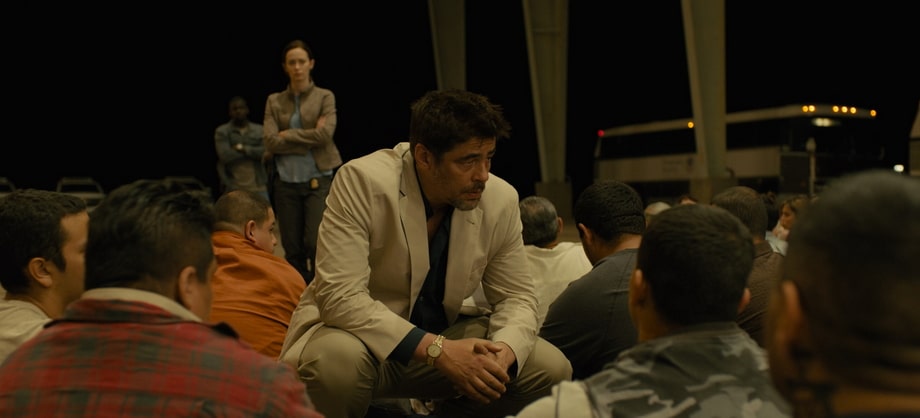
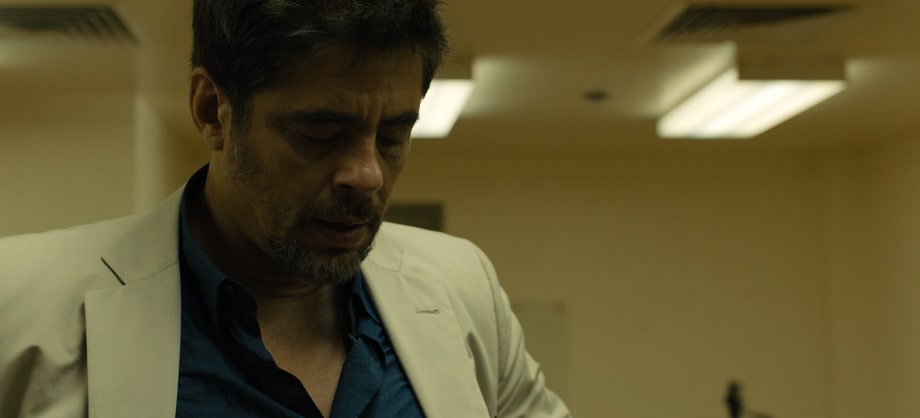
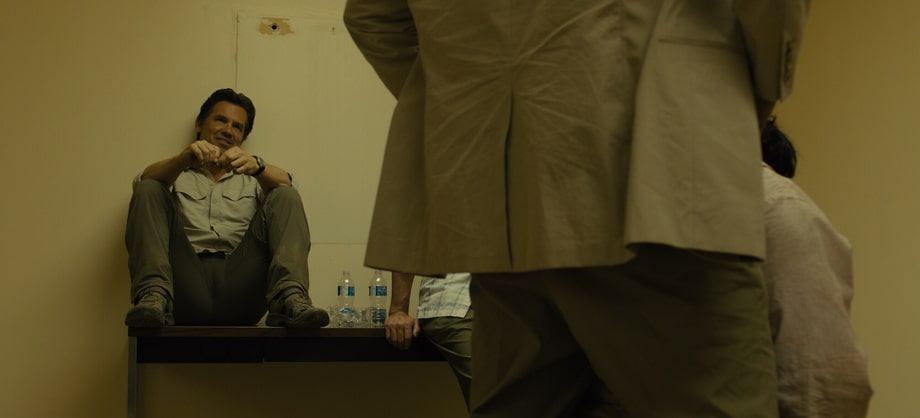
Another interesting scene, which I want to analyze, is the improvised interrogation scene between Matt (Josh Brolin), the captured brother of a drug lord, and later Alejandro (Benicio del Toro). In contrast to the vast panoramas of previously shown Mexico-American border, this scene feels claustrophobic and fully renders the tight environment and the lack of choice for the object of interrogation. He is kept in the room without doors, buttoned up to the chair with several CIA agents next to him. When Benicio del Toro’s character comes in, first, we see how Guillermo is lost in the empty background with confusion and horror on his face. The environment of the room steamrolls over him, stuck in the chair. When Alejandro comes closer, he starts to dominate the frame, cutting it into two parts. What is even more interesting is that Deakins leaves the second part of the frame for the distant look over Matt (Brolin). Other cinematographers would probably mix the close shots of three characters in the room, but Deakins shows us the indifference of Matt and even his adoration of Alejandro’s methods, which corresponds with his own. In a wider sense, we not only understand where the characters are, in what kind of a place, but what it means to be present in this room for each of the characters at this point in the story. When the scene ends, we do not see the torture scene itself, but hear the details while seeing only the sewage hatch.
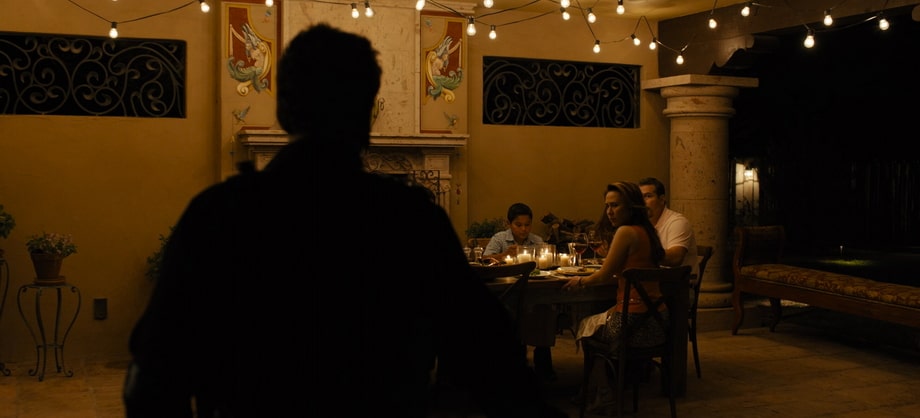
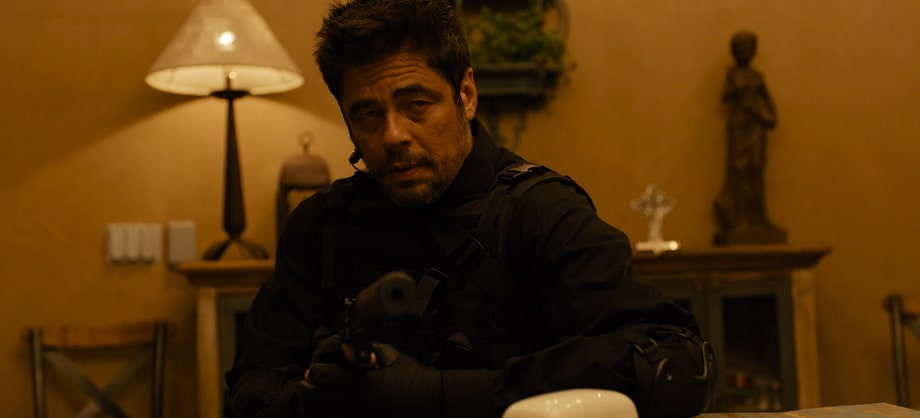
I will not analyze the secret tunnel mission here, since framing there plays a smaller part than lighting, but our next stop should deal with the final stage of that mission, when Alejandro (Benicio del Toro) reaches the house of his long-time nemesis. When Alejandro comes close enough to the family at the table, we see his back, a pistol, and all four family members in one shot. The camera thus includes all important information, particularly their reactions, into one frame. When this establishing shot makes way to the subsequent one, we see the reverse picture: the drug baron from the back, and Alejandro, who stands in the shadow on the left part of the frame. When the camera focuses on the drug king, Deakins puts him in the middle of the frame, thus creating a feeling of importance of this character, or better to say, he still possesses an illusion that he is important and can master this tuition with words or a request for mercy for his family and even himself. This time, the target was put into the dark background with a lack of visual information except for himself, while Elajandro is calm, focused, and he is the one who controls the situation. Sicario does not need to exploit violence, as we don’t see the murder of the wife and two boys explicitly, but only the reaction on the family patriarch’s face. He asked not to be killed in front of his boys, but Alejandro did the opposite by killing the family in front of him, before finishing this target, who had not a single chance to survive this conversation.
THE LIGHT AND SHADOWS
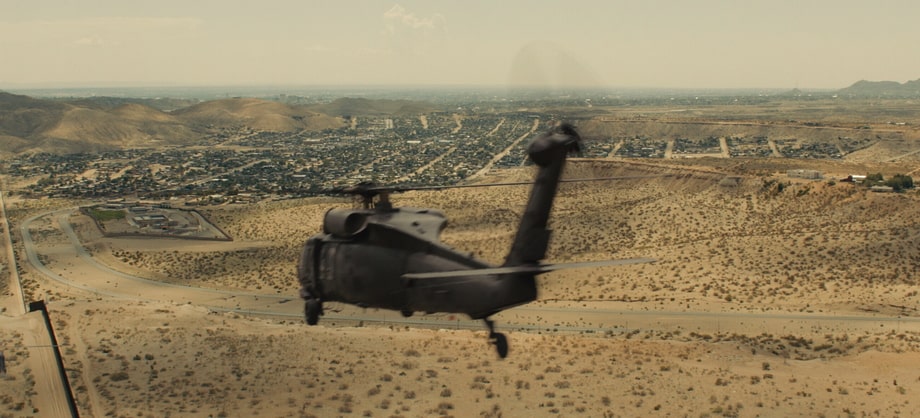
What differentiates Roger Deakins as a master cinematographer is the skilful use of natural, or better to say naturalistic, lighting and putting visual information into shadows when needed. I have previously analyzed the ‘motivated lighting’ in my analysis of cinematography in Seven, and Deakins is another example of a cinematographer who rarely uses plenty of artificial lighting and who is very conservative in the number of sources of illumination in his scenes. While in Prisoners, the previous work with Denis Villeneuve, he did a great job in creating a stuffy indoor environment, Sicario is better known for its outdoor scenes. His devotion to natural light is palpable, starting from the opening scene in the mansion, which occurs during the day with many windows. The following shots of the wastelands of the Mexican-American border, sun-drenched landscapes, work perfectly because of the natural lighting and the feeling of authenticity of the shots. The movie does not use color correction, at least it does not exploit it beyond necessity in post-production, which makes Deakins’ lighting and framing work as if they were pre-recorded and staged. We have previously seen this profound realism in ‘The Shawshank Redemption’, ‘Fargo’, ‘No Country for Old Men’, ‘The Reader’, and ‘True Grit’, all works of Roger Deakins, and in Sicario, he brought this realism to a new level. We feel present. In addition, the extensive use of helicopters or drones for the panoramic shots reminds us of the omnipresent surveillance means that are used today.
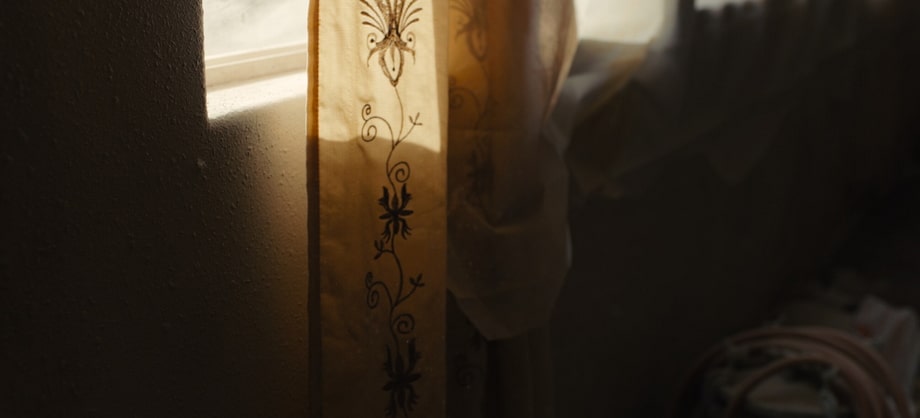
In parallel to the use of blinding sun for creating a scorched landscape in day scenes, in Sicario, Roger Deakins masterfully worked with the shadows. The concept of putting something or someone’s ‘bad’ or mysterious into the shadow is as old as cinematography, but here Deakins put the approach on a new level. In the opening scene, the sunlit panorama of the neighborhood and a mansion is mixed with the dungeon-like interior of the SWAT armored vehicle, and later makes space for half-lit rooms inside the mysterious house. In the first instance, police officers wore black uniforms, and they were moving toward the unknown, for the audience as well. In the second, apart from armored criminals in the mansion, the house has its dark secret: dozens of bodies in plastic bags hidden in the walls. When Kate and her partner reveal this finding, the shots with the bodies look and sound like taken from a horror movie or a detective story about a serial killer, rather than a crime drama. In the opening scene, the lighting defrauds our expectations: a sunny day and an unremarkable house make space for horror inside.
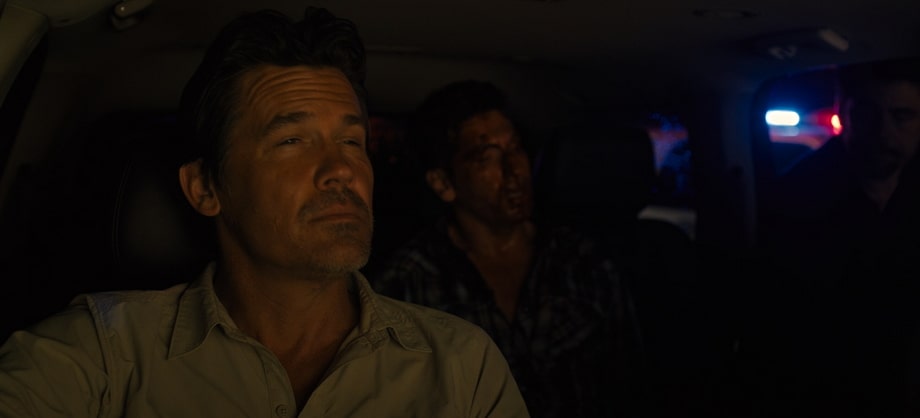
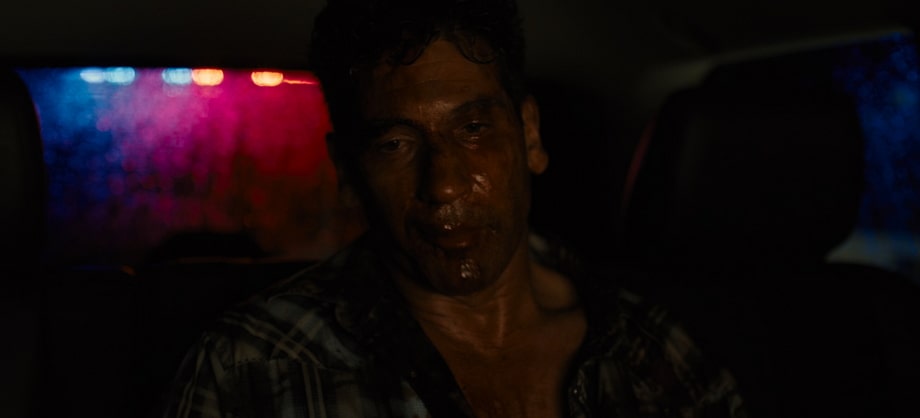
Another interesting scene that is worth the light and shadow analysis is the interrogation scene of a corrupt policeman played by Jon Bernthal (approximately 72nd minute). The whole scene is poorly lit with police flashing lights in the background. Bernthal’s character got most of the limited light on his beaten face, while Matt (Josh Brolin) and especially Alejandro (Benicio del Toro) are kept in the dark. We see Matt mostly from the point of view of the mirror with his eyes in focus. It underlines his control over the situation and over the situational prisoner. The point here is that, despite being a cop and surrounded by other policemen, no one would help Bernthal’s character, no one would save him from harsh treatment, and his daughters from revealing their address on the internet, if Matt is willing to do so. Alejandro resurfaces from the darkness like the horseman of apocalypsis to make the interrogee speak, but as I said before, the control of the situation here is in the hands of a CIA agent. This scene, especially its lighting techniques, reminds me of the movie by David Fincher, especially ‘Seven’ and ‘Fight Club’.
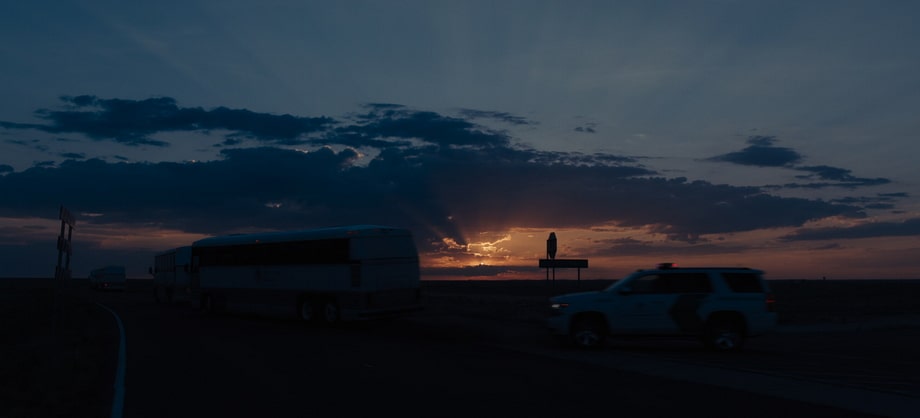
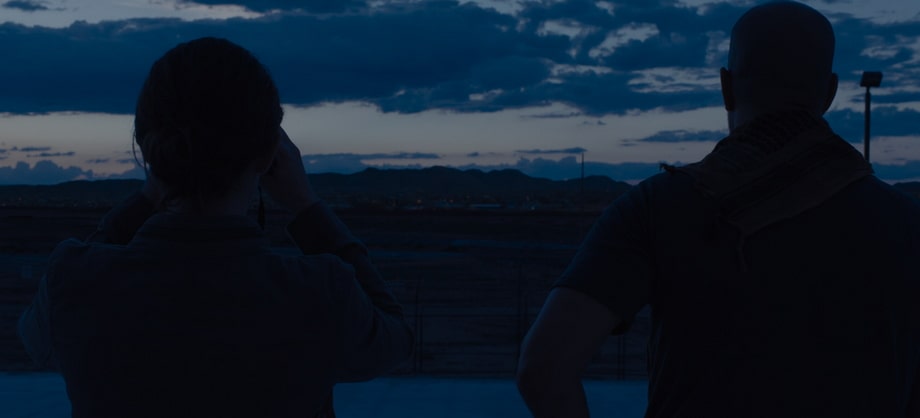
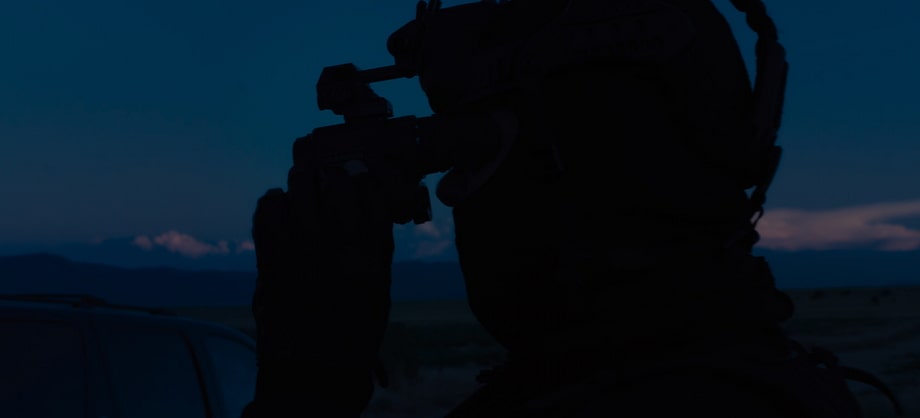
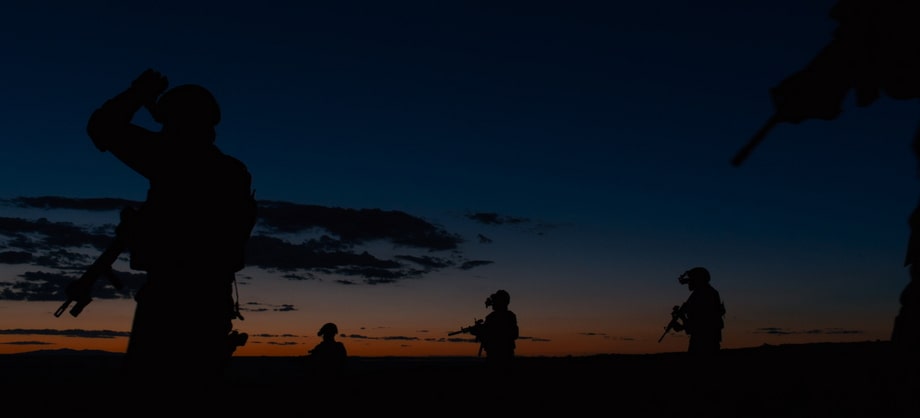
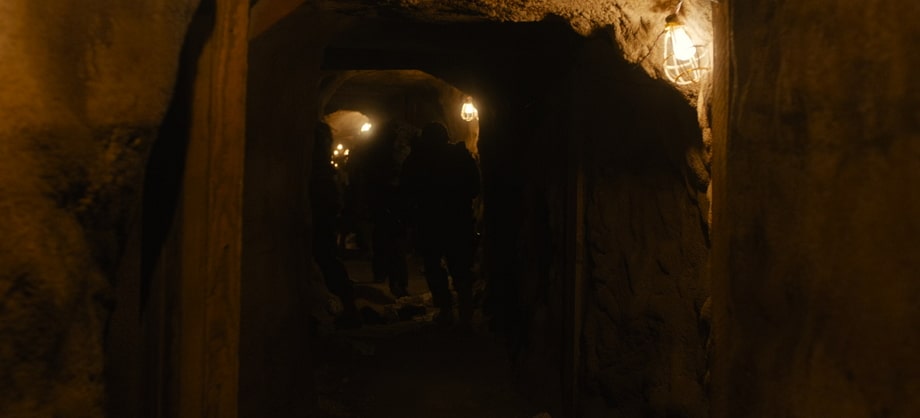
No Sicario cinematography analysis could be complete without addressing probably its most recognizable sequence, with a squad team headed by Matt and Alejandro descending into the tunnel, literally into the darkness. In most cases, when someone mentions Sicario and its lighting techniques, they use the shot with a squad team with the remnants of the sunset in the background. Regarding the fact that Roger Deakins generally performs meticulous, detailed planning for every scene, we must understand how difficult it is to shoot a scene when you have only maybe ten minutes each day to catch the perfect natural light. This is why the scene looks amazing and serves as a carte-de-visite for the whole movie. The Delta squad descends into the darkness of the unknown, into the dungeon with drug dealers and corrupted policemen instead of dragons. Apart from this, the character of Kate is still kept in the darkness by Matt and Alejandro, considering their true goals and her role. The sequence also uses the night vision and the flashes from the gunshot as the only source of light.
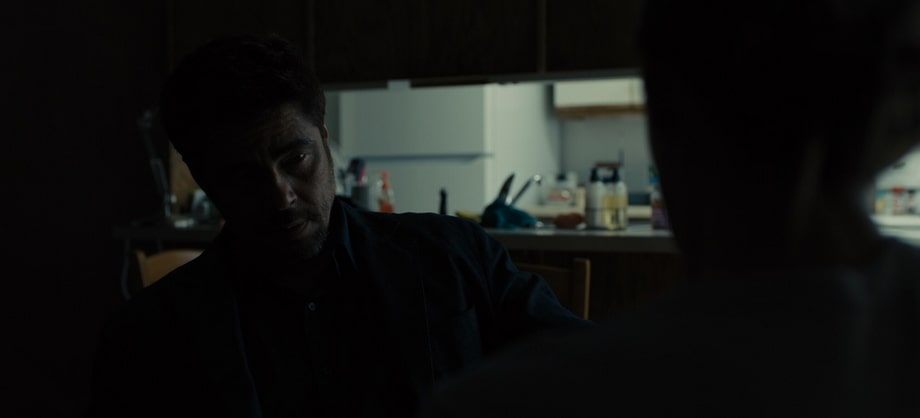
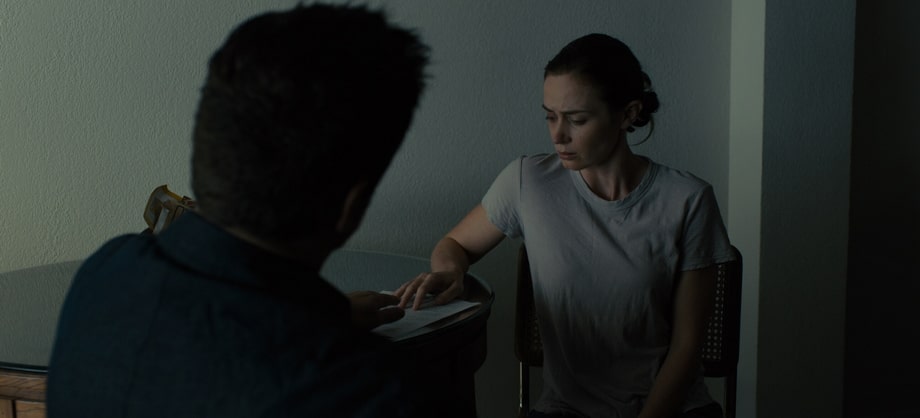
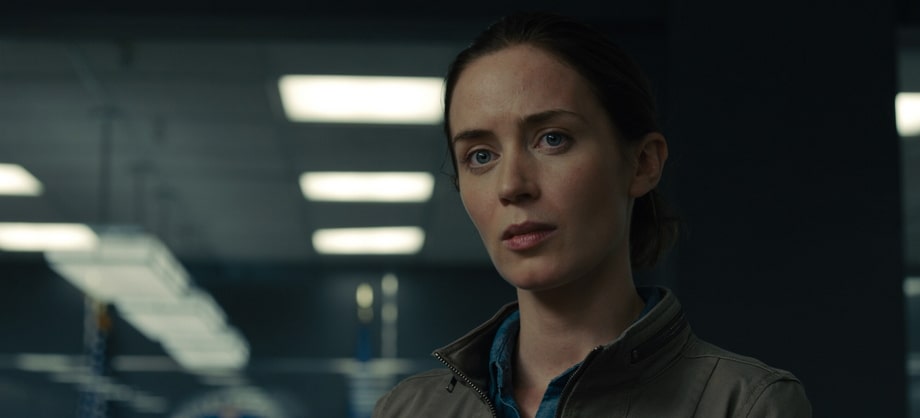
As I underlined before in the sequence when Alejandro confronts the drug king’s family at the table, he emerges from the darkness into the warmly lit location. Later on, we get another pivotal scene, when Benicio del Toro’s character comes to Kate’s house to make her sign the paper beyond her will. The two characters sit in front of each other, and the cinematographer here used different lighting levels for each of them. Kate sits with a white background, and her face is better lit than that of Alejandro, who is swallowed by the dark background, and all we see is a part of his face. Such a look makes his character even more mysterious and menacing, since we finally understand that the movie title Sicario means Alejandro. He does not need to raise his voice or directly threaten Kate with a gun to look and feel dangerous. On the other hand, Kate’s character is perceived as an open book, extremely vulnerable in her beliefs. Till the very end of the scene, we can’t be sure whether both characters will survive to the end, which once again intensifies suspense and uncertainty.
PURPOSEFUL CAMERA MOVEMENT ANC COLOR PALETTE
Like the movies of David Fincher, whom I have recalled before, the camera movement in Sicario does not perform unnecessary movement. Yes, in Fincher’s movies, it generally moves only when characters move, but Roger Deakins, as a cinematographer, sticks to the same pattern of purposeful movement. Let’s recall The Shawshank Redemption or a more recent breathtaking example in 1917. The key point here is to make the camera unnoticeable to intensify the feeling of presence and focus on characters and their interaction. A calm, controlled work of the camera can also aggravate the suspense effect, since it contrasts with the intense or horrifying events, and you feel helpless to make an impact on the cinematography. If necessary, it does not shy away from violence or disturbing images, even without a specific focus. In the case of Sicario, this deliberate emotionless onlooking reminds us of surveillance techniques, which are widely used in the story. In a more narrow sense, this approach of purposeful camera movement creates a feeling of documentary footage without empathy or judgment.
The use of long motivated shots in Sicario lets us not only focus on the events, but on the characters’ reactions and emotional state, which perfectly works with Emily Blunt. Leaving behind the opening sequence, we see Kate hurt and vulnerable in her bathroom, and the camera deliberately moves a little to show her current state. In the following scene of recruitment by Matt, the camera is almost steady, catching all the participants in one frame, or focuses on either Matt or Kate. If we take a closer look, the camera is not fixed but shows tiny movements to make the shots look more lively. Further, when we see the famous camera flight from a helicopter or a drone above the Mexican-American border, this observation style with a focus on its matter creates a feeling of inevitability. Even during the intense scenes of gunshots between Matt’s squad and the drug dealers on the highway and later in the tunnel, the camera is calm and remains remarkably steady despite intense and violent action sequences. It emphasizes the cold-blooded and calculated approach behind Matt and Alejandro’s missions, and, on the contrary, the helplessness of Kate to change something in a meaningful way.
As I mentioned above, Roger Deakins generally invests so much time and effort in the preparation and work with natural light that the directors with whom he works rarely intensively use color correction in post-production. This helps the image to look more natural and, once more, improves the feeling of presence. Deakins uses color as a cinemographical tool not just to make the frame look good, but to create a specific mood and emotional background both for the characters and for the audience. In Sicario, the movie exploits the desaturated color palette, which makes the natural shots with the sun look amazing on the one hand, and creates that scorched desert effect on the other. It feels like the sun has scorched the surface of the United States and Mexico, since the yellow and brown tones dominate the color palette in most of the outdoor scenes. This desaturated palette emphasizes the cruel nature of this world and, as we find out the true motives of Matt and Alejandro, thus blurring the lines between good and evil. right and wrong.
VULNERABLE PROTAGONIST AND THE LACK OF HAPPY END
In this section, I am not going to focus attention on the story itself, but on how Sicario’s cinematography reflects Kate’s (Emily Blunt) reaction to the events. While Blunt looks confident in the action movies like ‘Looper’ and ‘The Day After Tomorrow’, her character still looks estranged during the opening sequence. Not because she is a female squad leader in a generally male world of violence and gunfight, but because she feels helpless in the ongoing war with the drug traffic. When the camera focuses on her face inside the armored car, Kate looks focused and disoriented at the same time. Focus on her mission and a desire to survive and to make her people outlive the mission, and disoriented since she had to fight the cartels on American soil. Later on, the understanding that all her previous work had had a little influence on the overall drug traffic made her a willing helper for CIA agent Matt and mysterious Alejandro. After finding dozens of dead bodies in the walls and after the explosion, Kate was hurt not only by the accident, but she was also mentally exhausted. She tries to hide this fact during the meeting with her boss and Matt and opts for a new mission. She feels she can’t control either the overall picture or her own life in a full sense.
One would ask, what techniques were used cinematically to emphasize the vulnerability of the protagonist? All the above-mentioned. The framing helped both Deakins and Villeneuve to focus our attention on essential things and on how key characters react to the events and each other. The work with natural lighting and shadows revealed that Kate tries to stay in the light of truth and justice, while Matt and Alejandro take advantage of her desire to change the world. The desaturated color palette boosts the feeling of realism, which, combined with Kate’s appearance (the lack of cosmetics), makes her a real person with feelings and thoughts, rather than a role model of a ‘strong woman’. The motivated camera movement becomes an unnoticed participant in the events and once again moves with the protagonist, thus emphasizing her impact on the story. It is reasonable to say that Kate Macer became the character that we know thanks not only to the masterfully written script by Taylor Sheridan, but also to the genius director’s work of Denis Villeneuve and cinematography by Roger Deakins.
At the surface, another entertaining comedy with Jim Carrey, Yes Man appears to be a self-helping guide for seeking a balance between proactivity on the one side and staying close to people and our core values on the other
The story of Eddie Edwards is a new brilliant and, in fact, underestimated cinematic reinterpretation of the underdog rise, which has lessons to teach us beyond ski jumping
This modern spy movie with Jennifer Lawrence took advantage of using Budapest as its primary filming location, thus combining the West and the East in one story
The driving force of the movie makes an incredible sense in viewer’s own inner world, reflecting the experience of Walter Mitty and adopting to ourselves
Apart from the conventional interpretation of Forrest Gump, I would deepen into the character analysis of every one of three main characters and their sense of purpose. Forrest Gump characters analysis




 3,00
3,00